
Description
About US:
Our photographs are taken without retouching or photoshop to ensure that the customer can judge the reality of the object. Thanks to a constant work directly with the best collectors, museums and galleries in Japan and friendship with them, along with a profit margin much lower than the European competition we can offer objects so that many people can choose to have authentic pieces with hundreds of years at more than competitive prices. After all, samurai art is our passion and we want to share it with the world.
About The armor:
It Comes with certificate of SupeinNihonto.
ITEM:
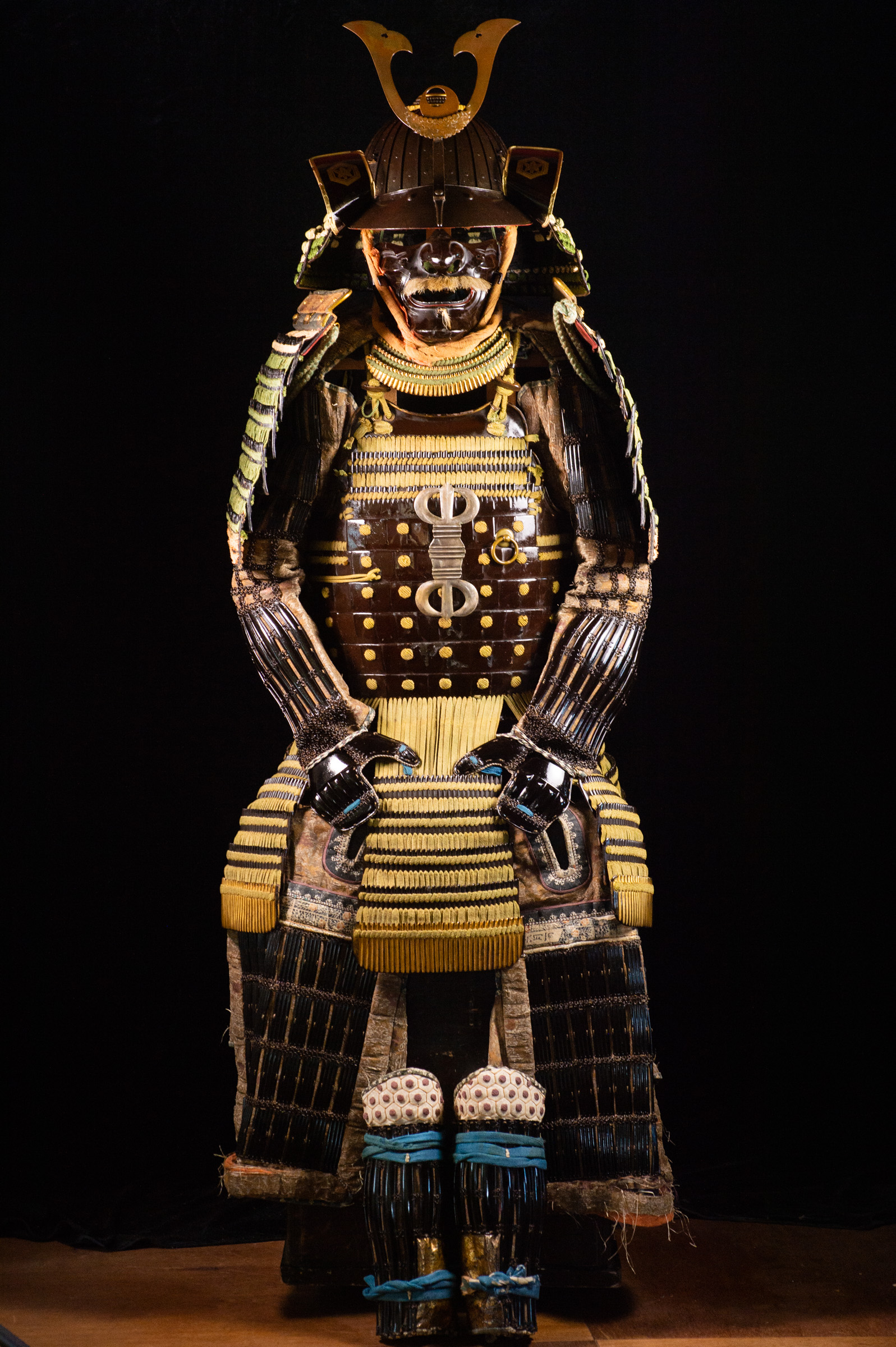
COMPLETE SAMURAI ARMOR (EDO PERIOD)
Narrative and Contextual Description
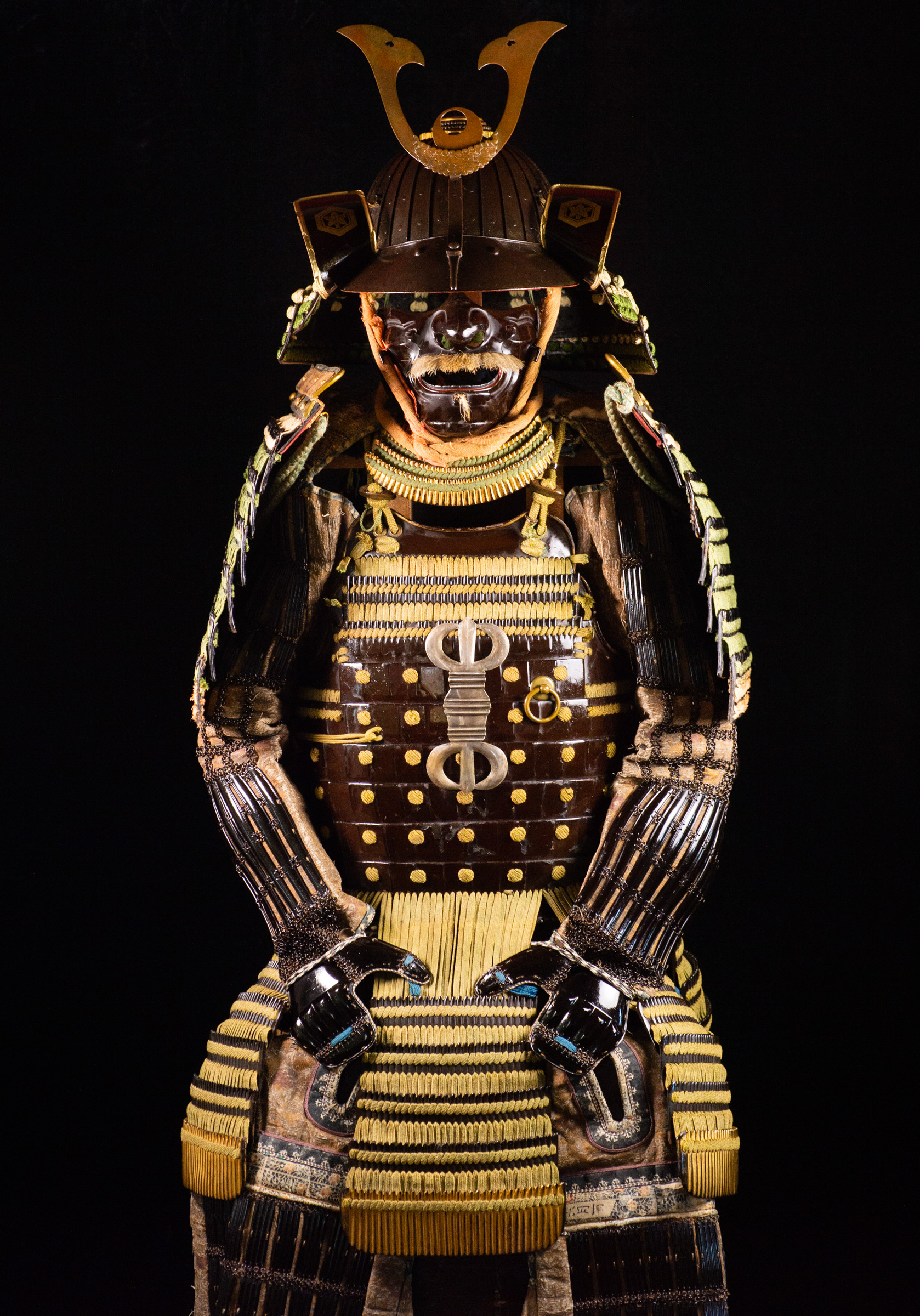
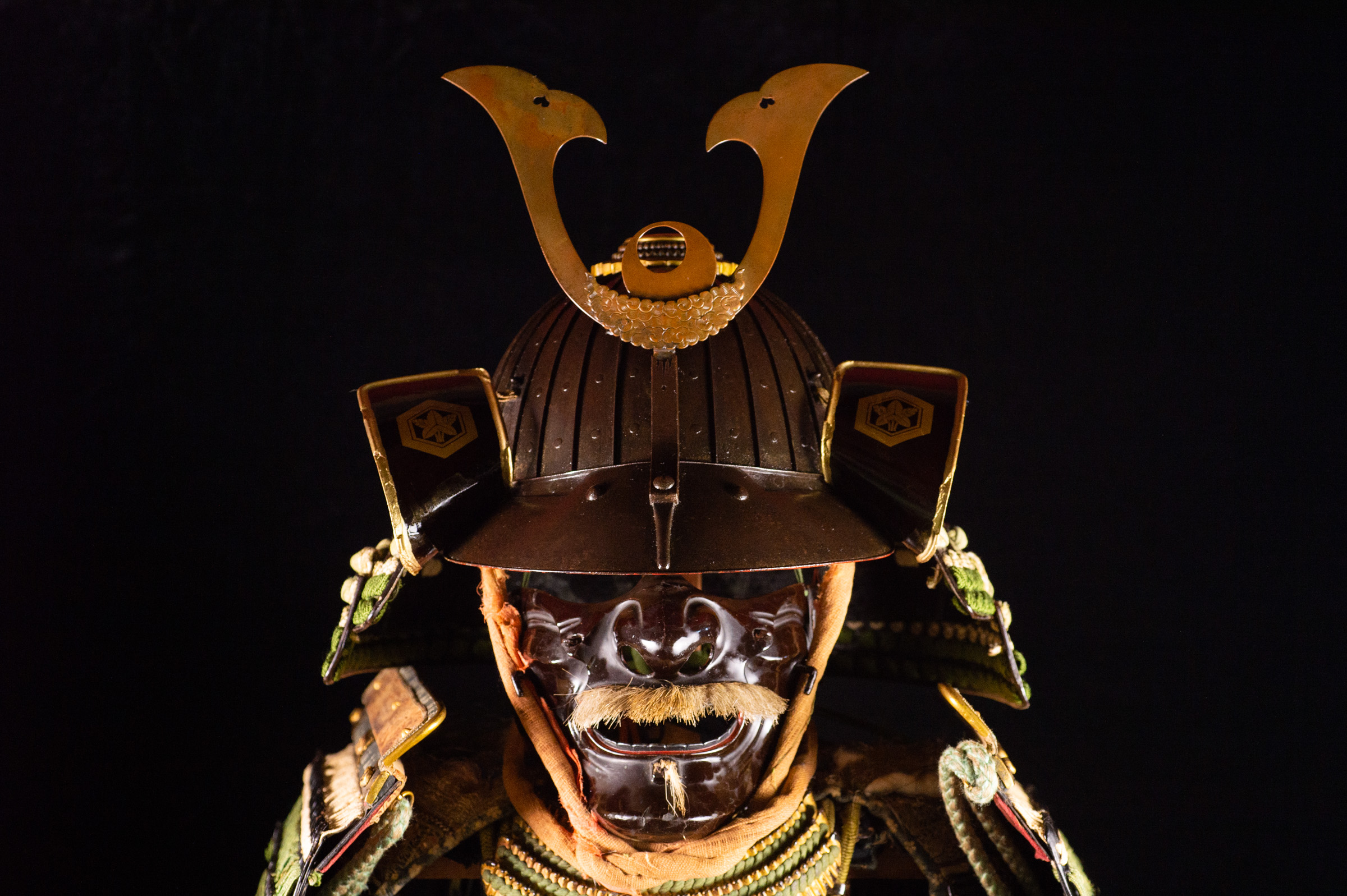
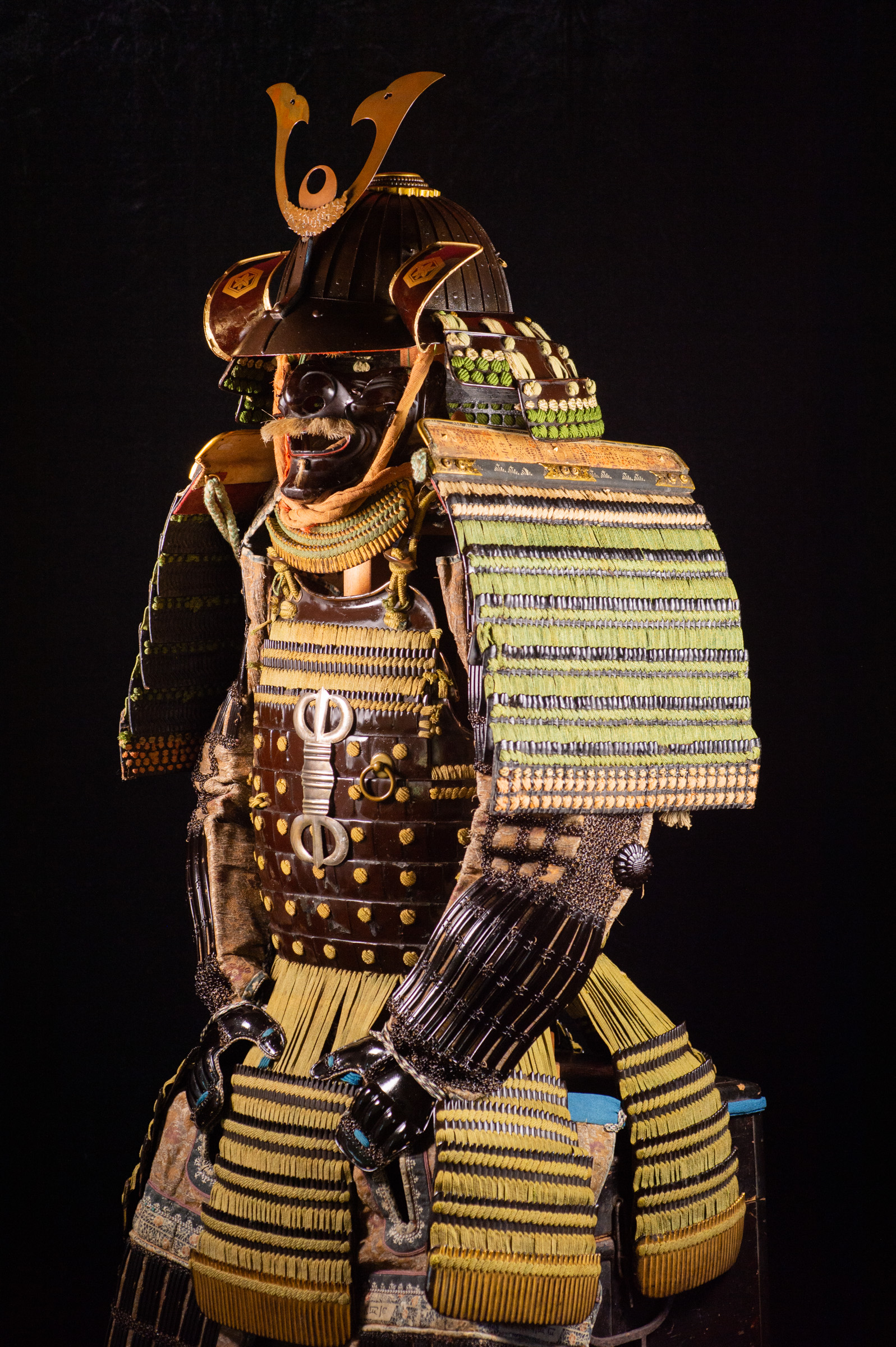
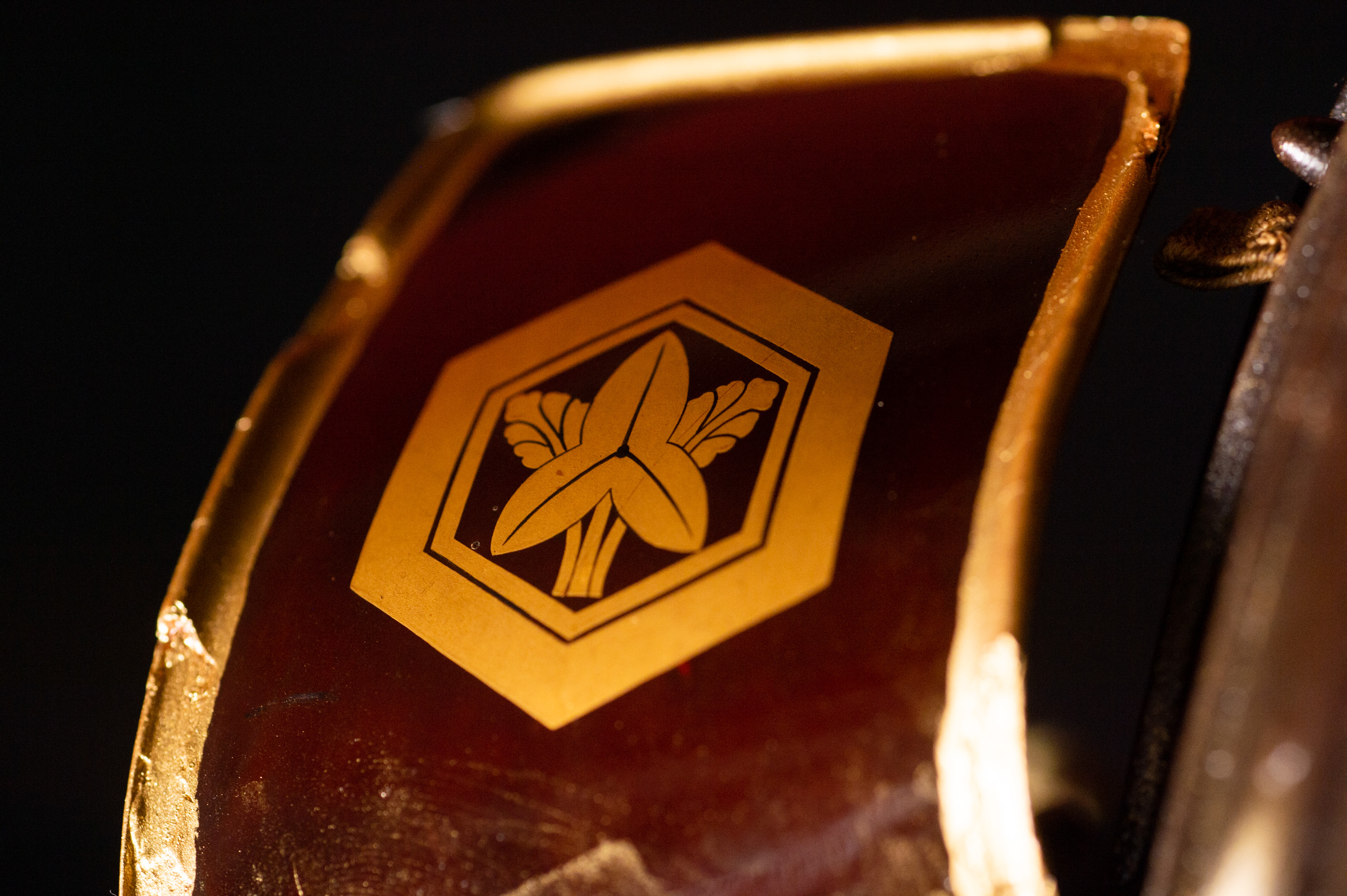
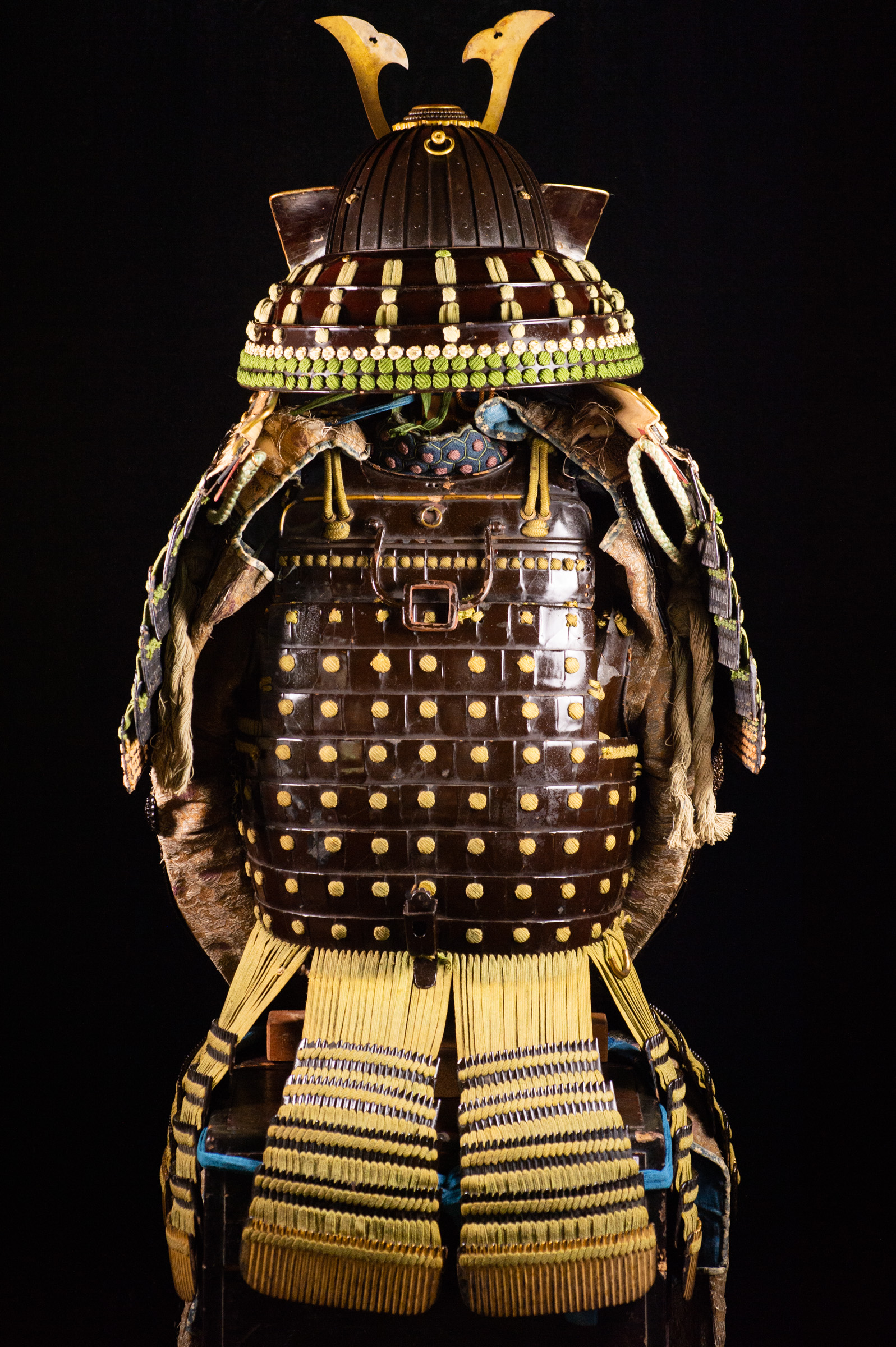
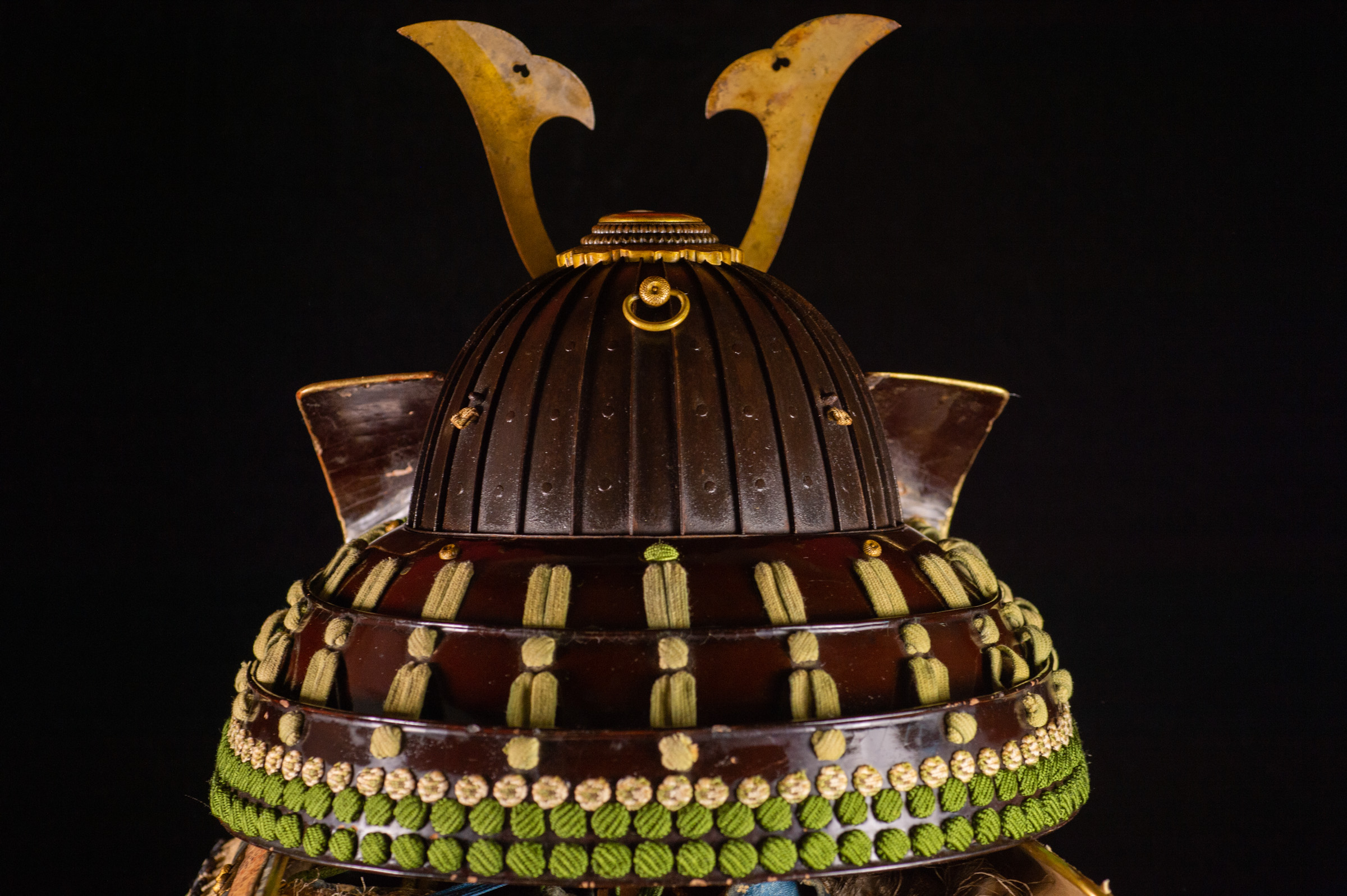
This is a complete samurai armor set from the Edo period, a highly refined and visually commanding ensemble that exemplifies the craftsmanship, symbolism, and aristocratic aesthetics characteristic of high-ranking samurai families. The deep brown lacquer, the carefully harmonized cord colors in shades of olive green, yellow, and ivory, and the striking golden maedate create an immediate sense of authority and prestige. The fukigaeshi display a clearly identifiable family crest (mon) consisting of three stylized leaves within a hexagonal frame, strongly reinforcing the armor’s association with a specific and distinguished clan.
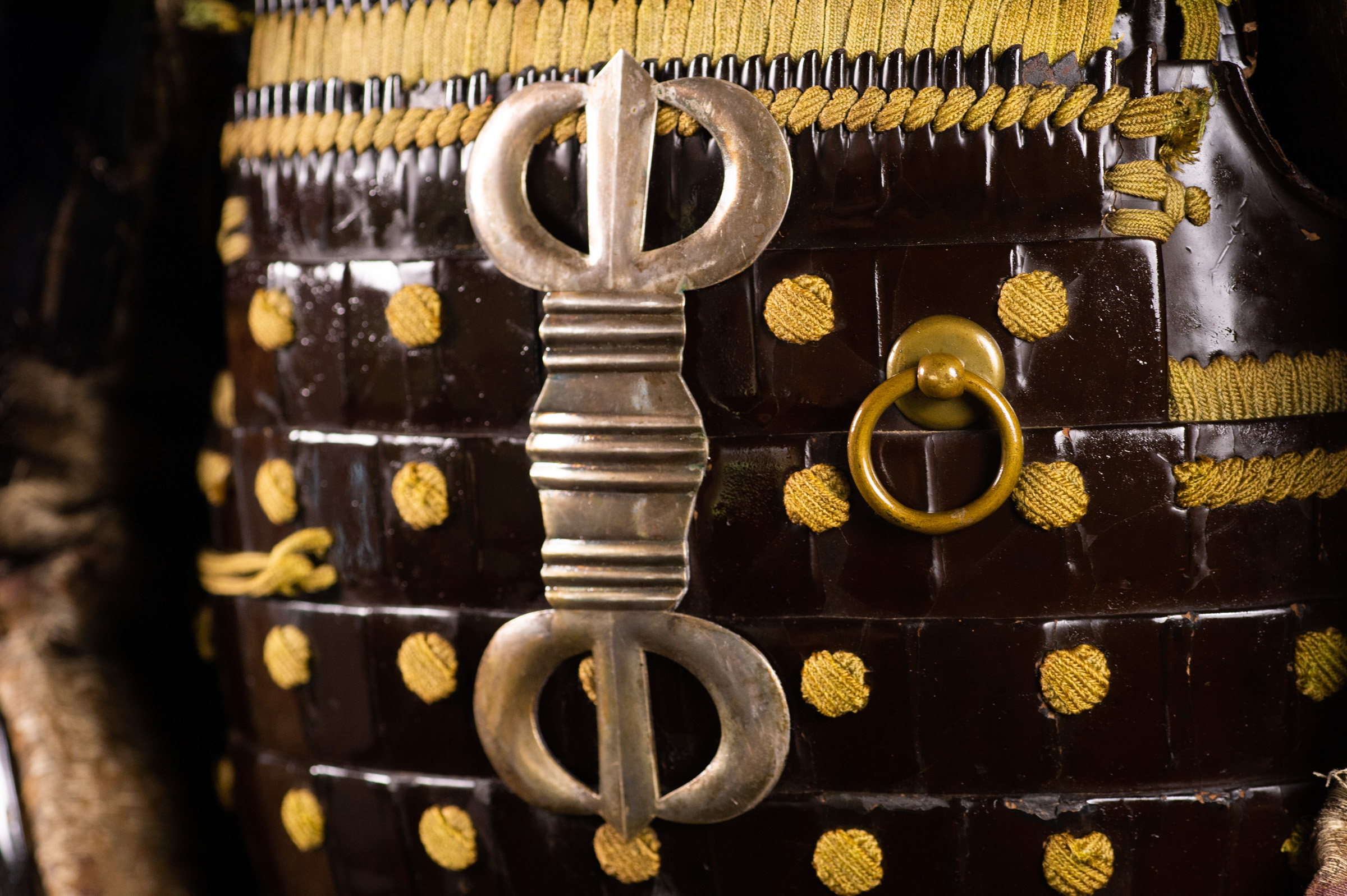
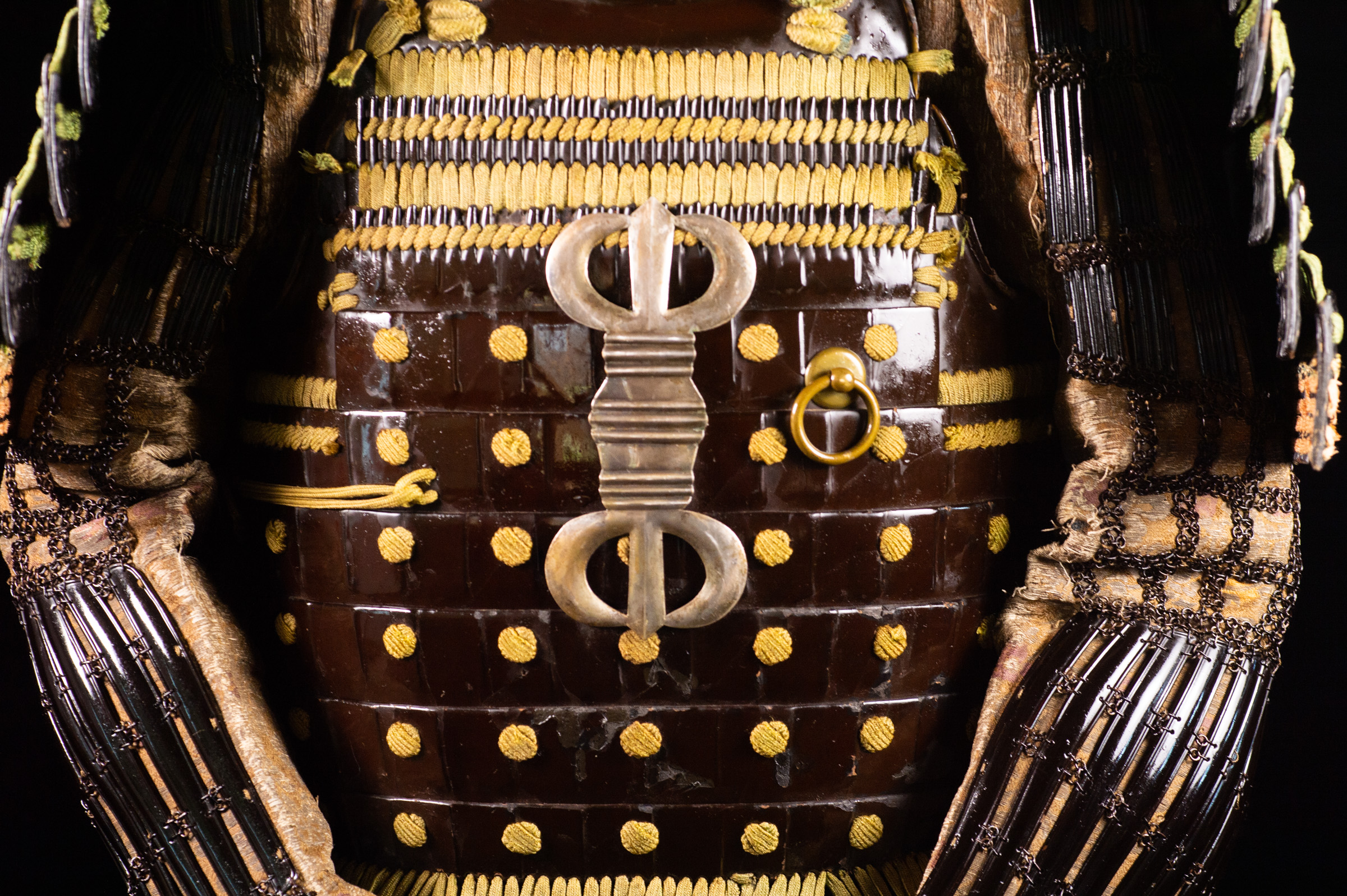
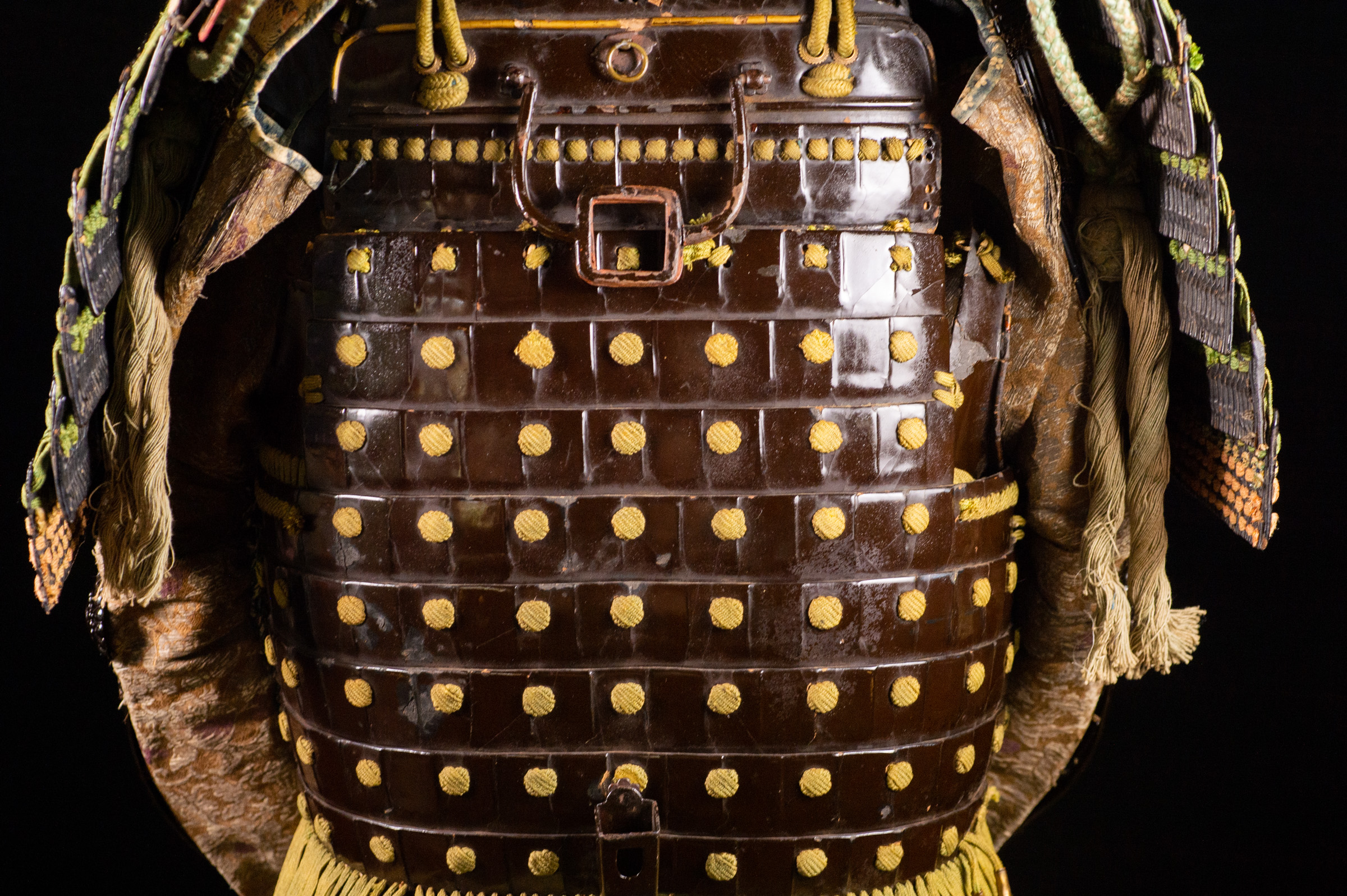
Beyond its visual elegance, the armor contains spiritual and symbolic depth. The central metal ornament on the dō stands out immediately: a symmetrical, stylized representation of a kongō-sho (vajra), the ritual weapon of esoteric Buddhism (Shingon). The shape, composed of two open pointed ovals connected by a ridged central shaft, is unmistakably inspired by the vajra’s iconography.
This emblem symbolizes indestructibility, spiritual clarity, and ritual power—qualities associated with the warrior-protector role of the samurai. Its placement at the center of the cuirass transforms the armor into both a physical and spiritual shield. Such esoteric Buddhist motifs were not decorative excess; they reflected the bushi’s adherence to disciplined conduct, righteous warfare, and the cosmological ideology of the Edo period. An armor bearing this symbol likely belonged to a samurai of education, status, and deep spiritual alignment—possibly from a domain with strong Mikkyō (esoteric) influence or close ties to major temples.
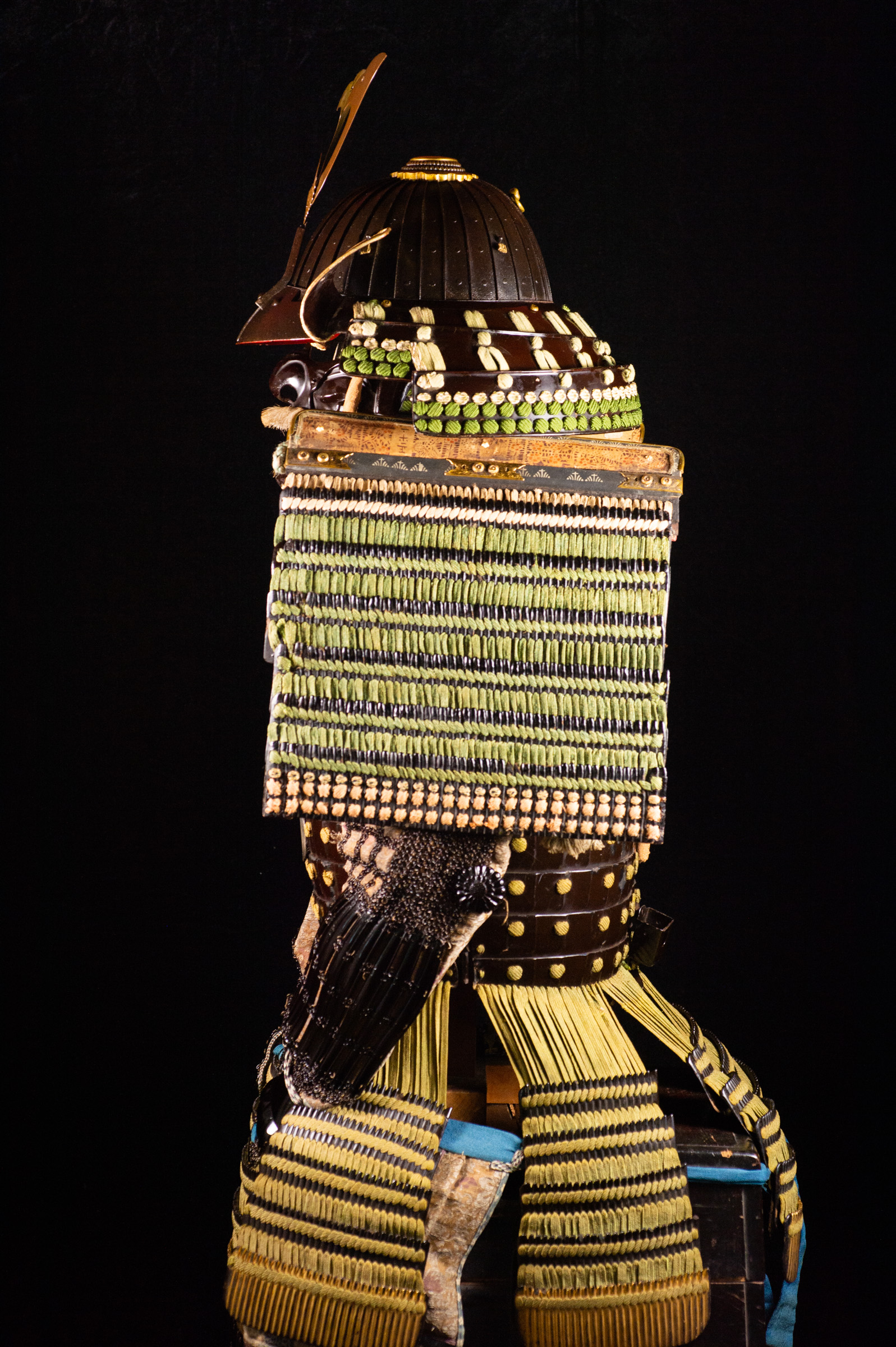
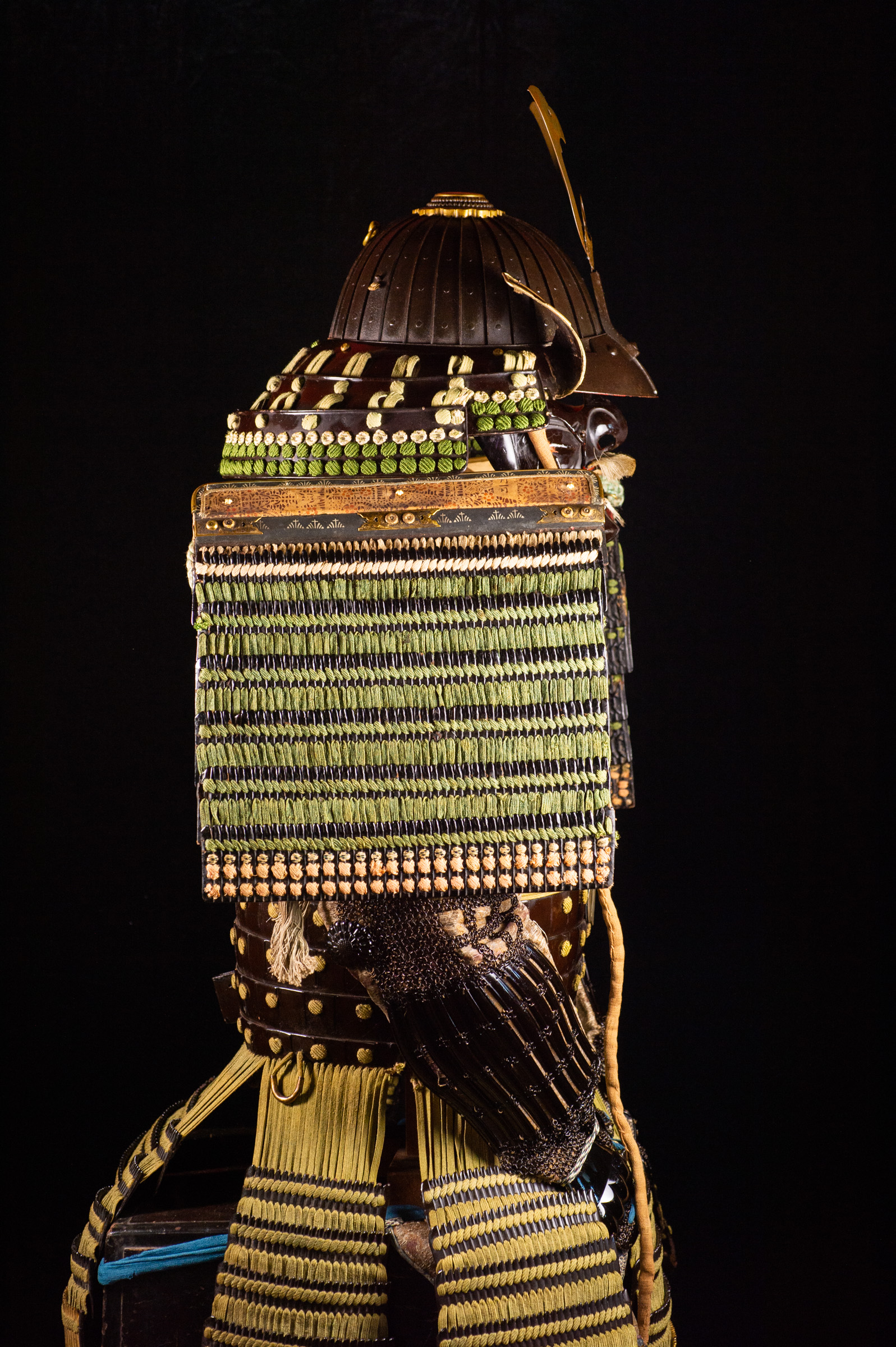
The entire set demonstrates a cohesive, high-level construction: a multi-plate suji bachi kabuto with an outstandingly detailed tehen no kanamono, a menpō with natural-hair moustache, robust kote combining lacquer plates and chainmail, richly laced sode, decorated haidate, and black lacquered suneate with hexagonal kikkō padding. Every component shows honest Edo-period wear and stable patina, creating a historically coherent armor with character and presence.
Technical Description — Detailed by Component
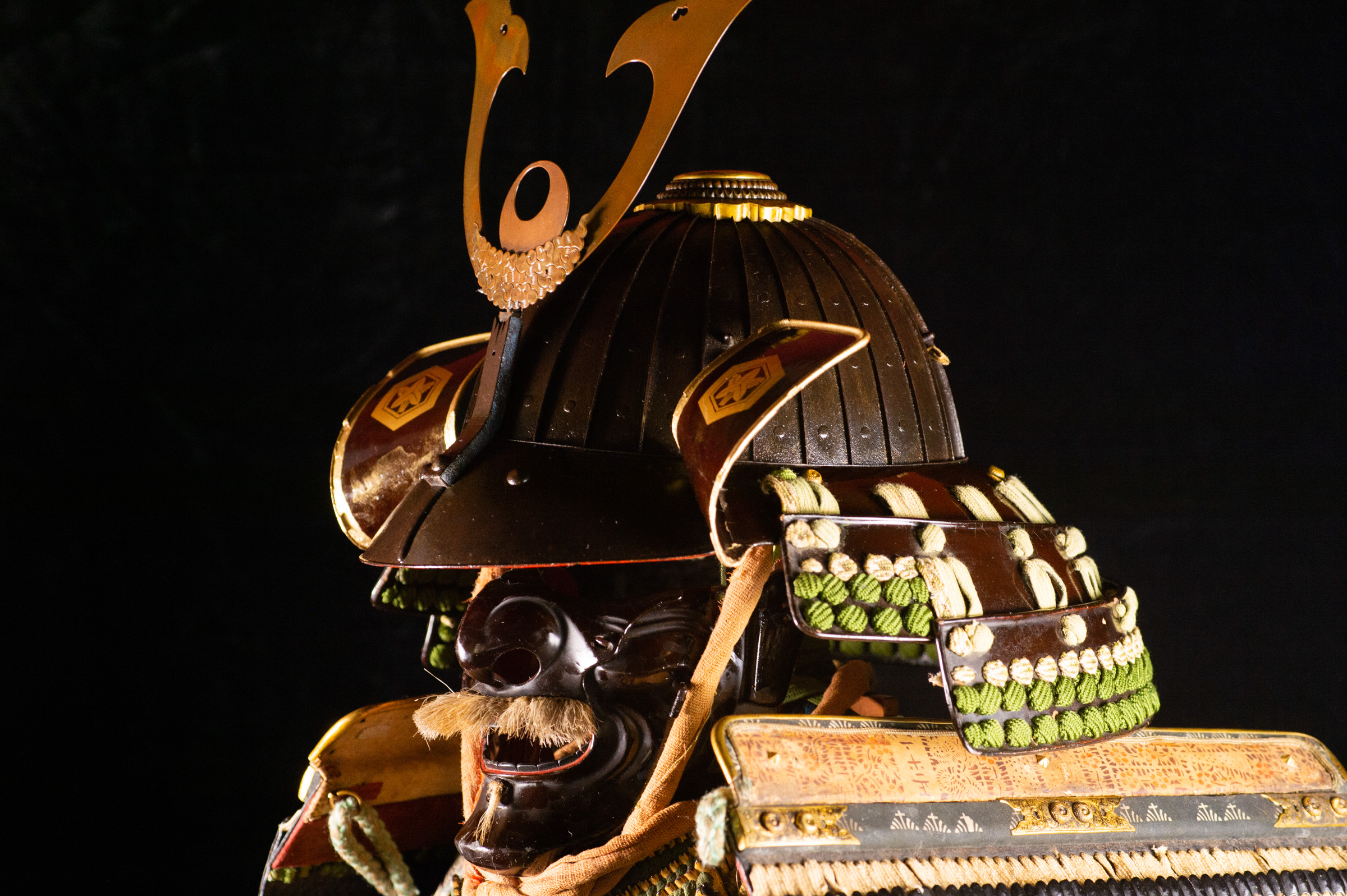
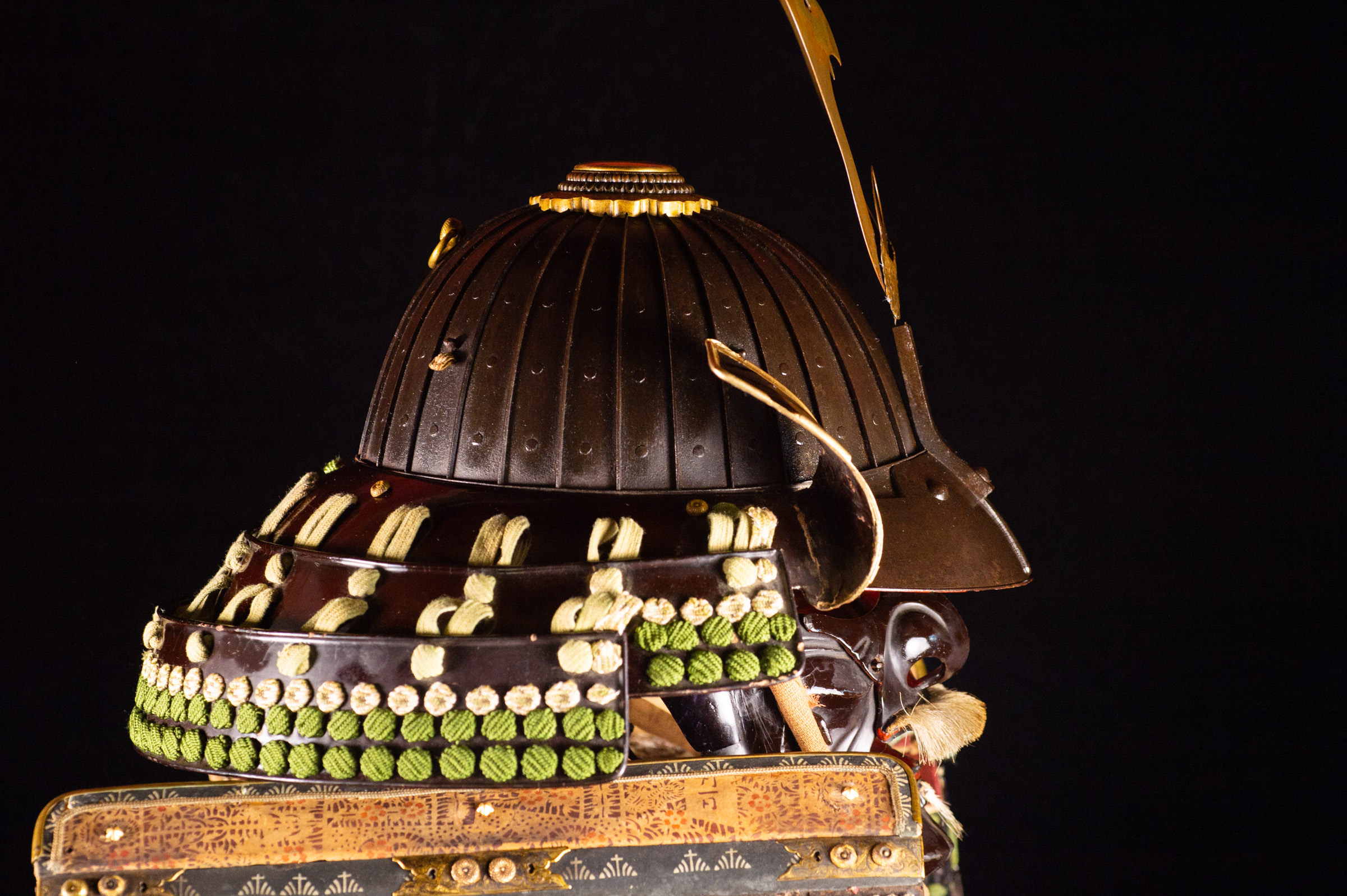
Kabuto (Helmet) — Suji Bachi
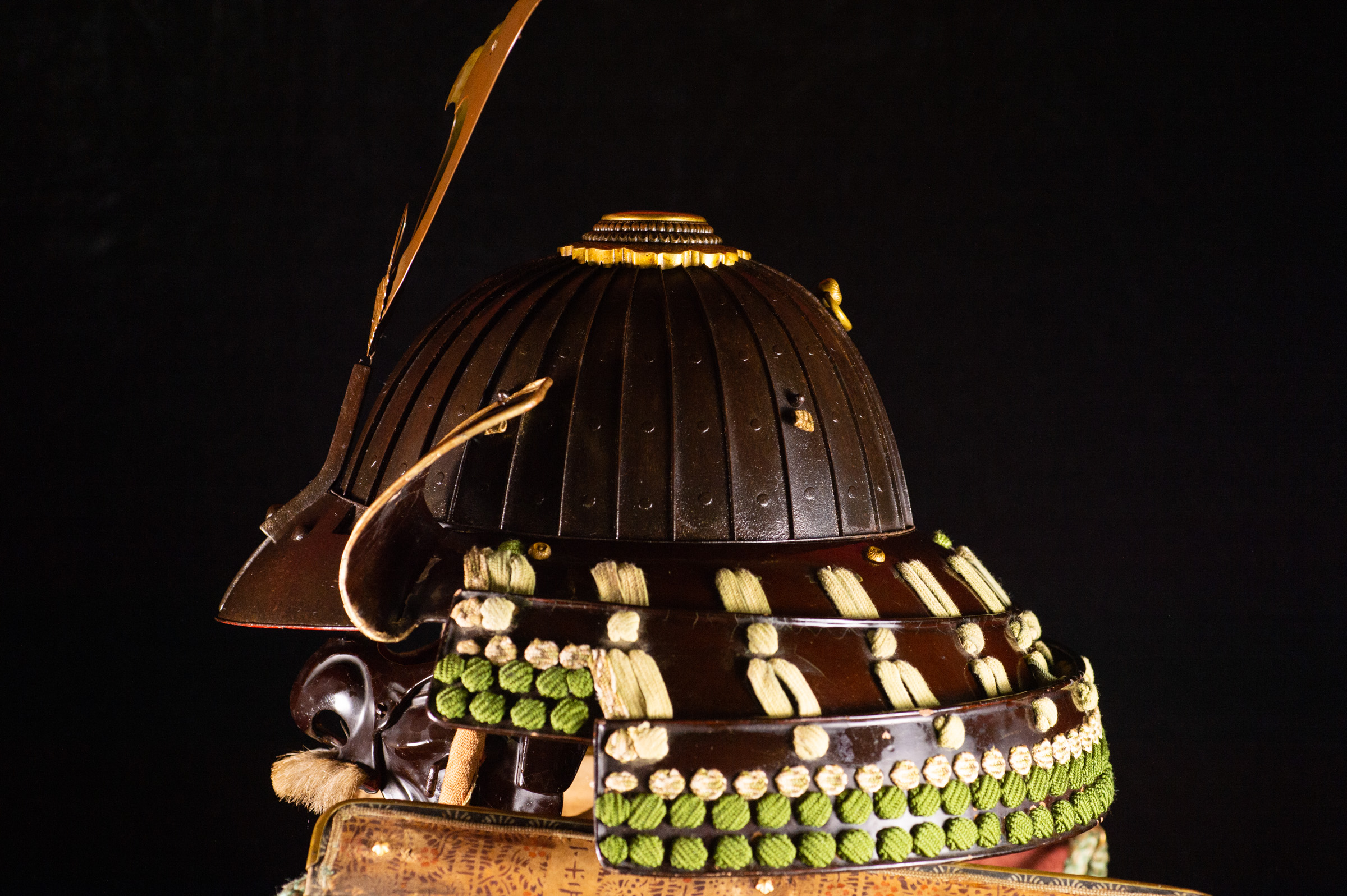
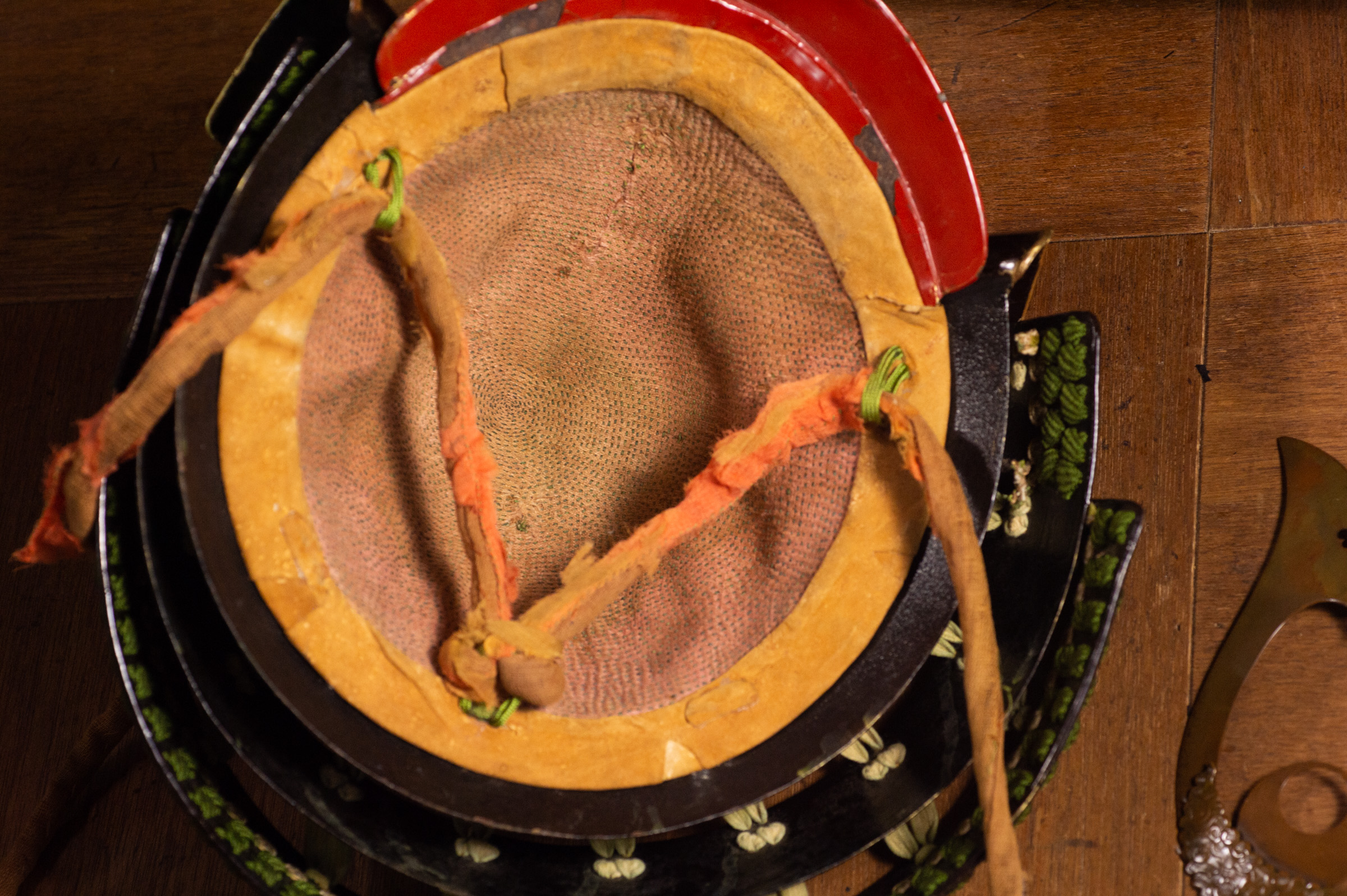
Traditional suji bachi construction consisting of multiple riveted vertical plates.
Deep brown / bronze-toned lacquer with well-preserved Edo patina.
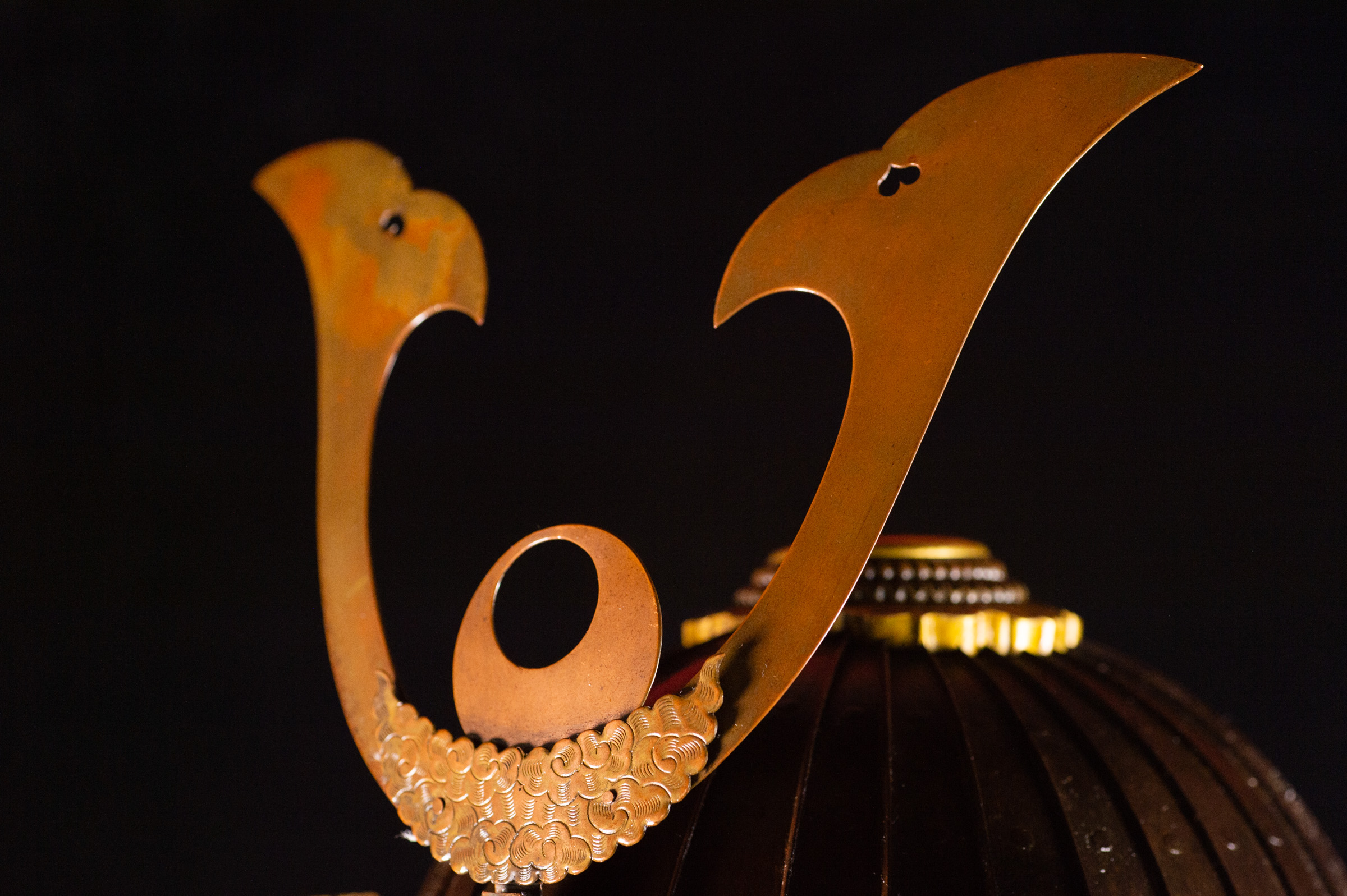
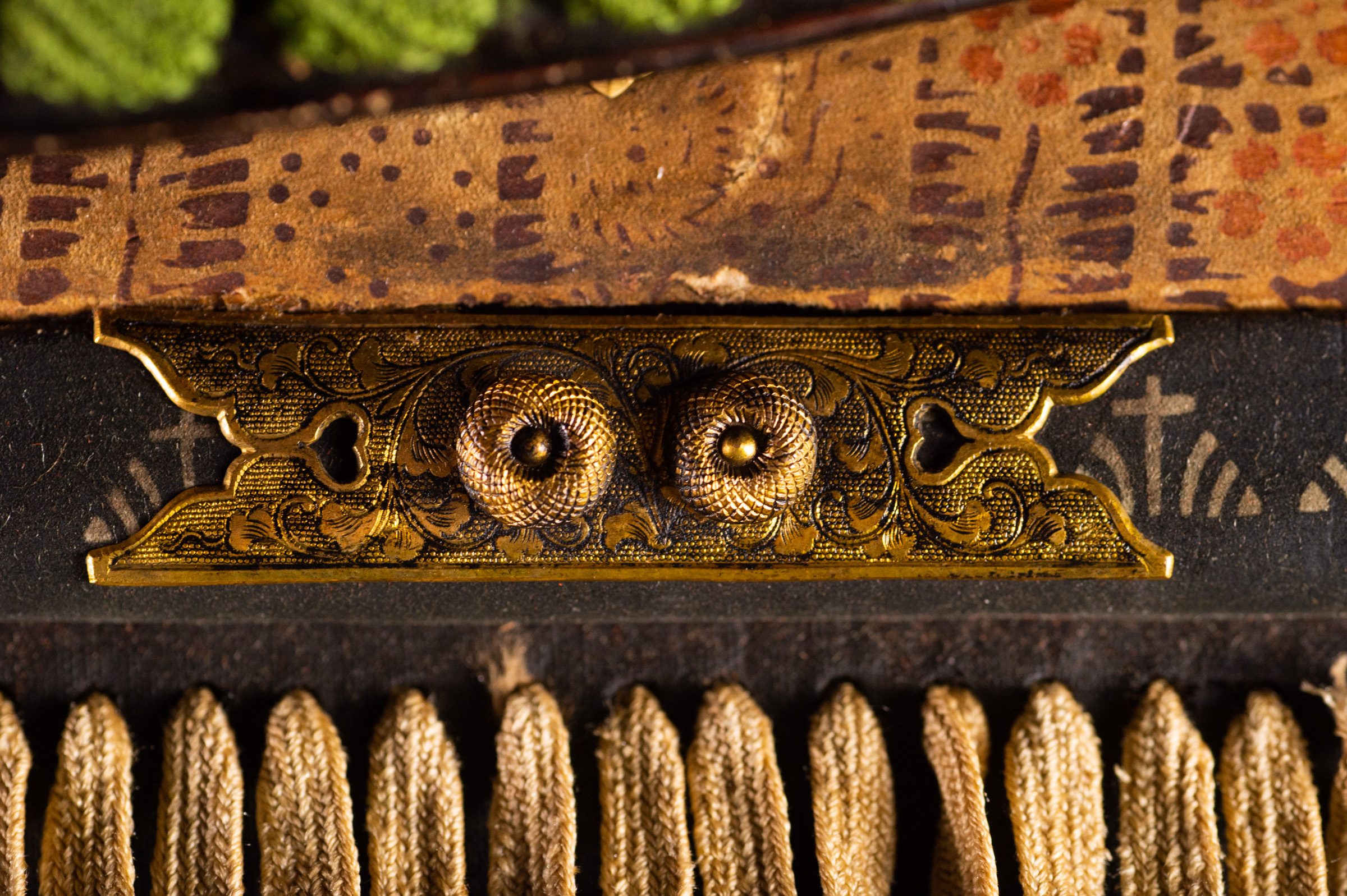
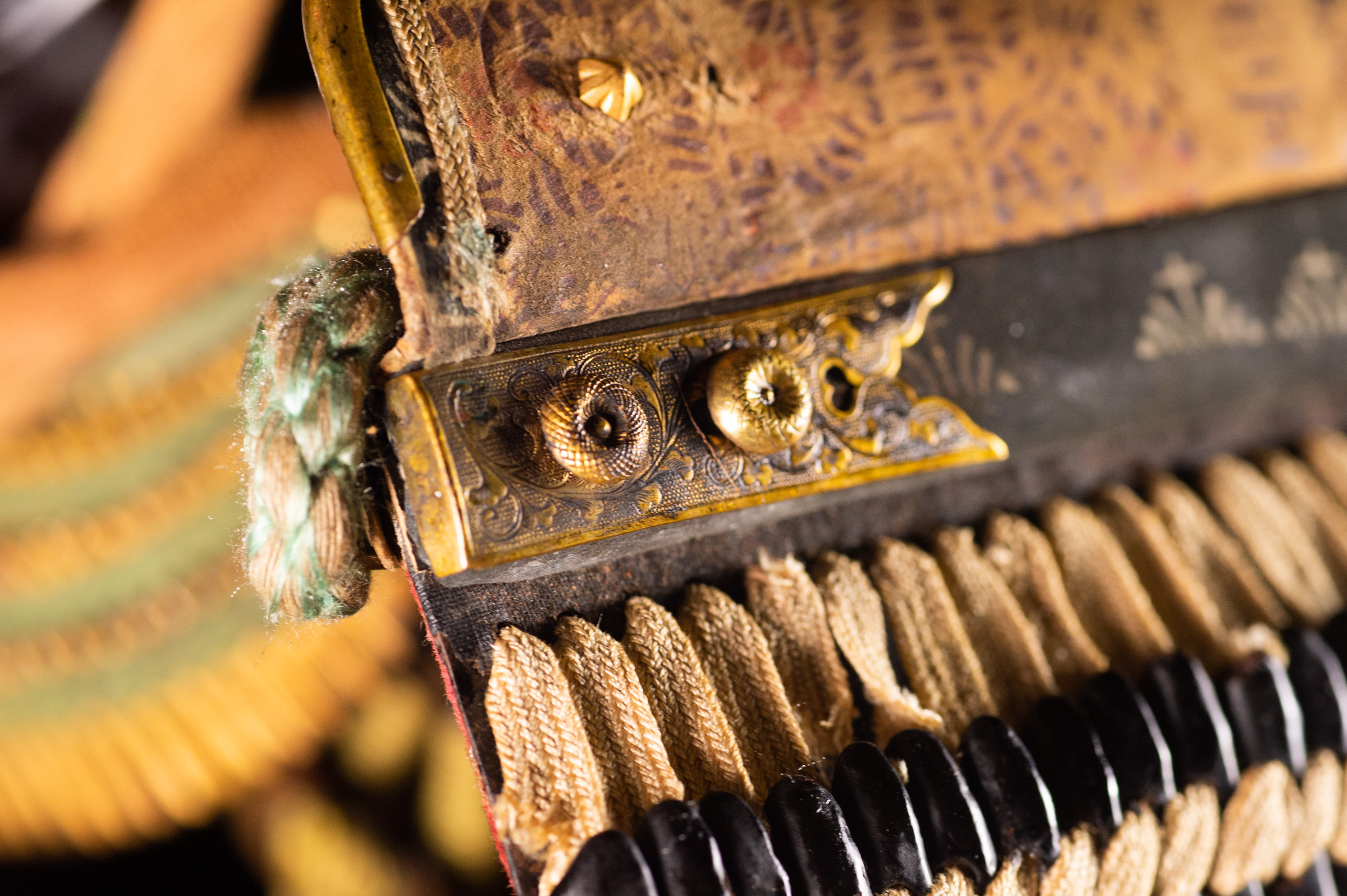
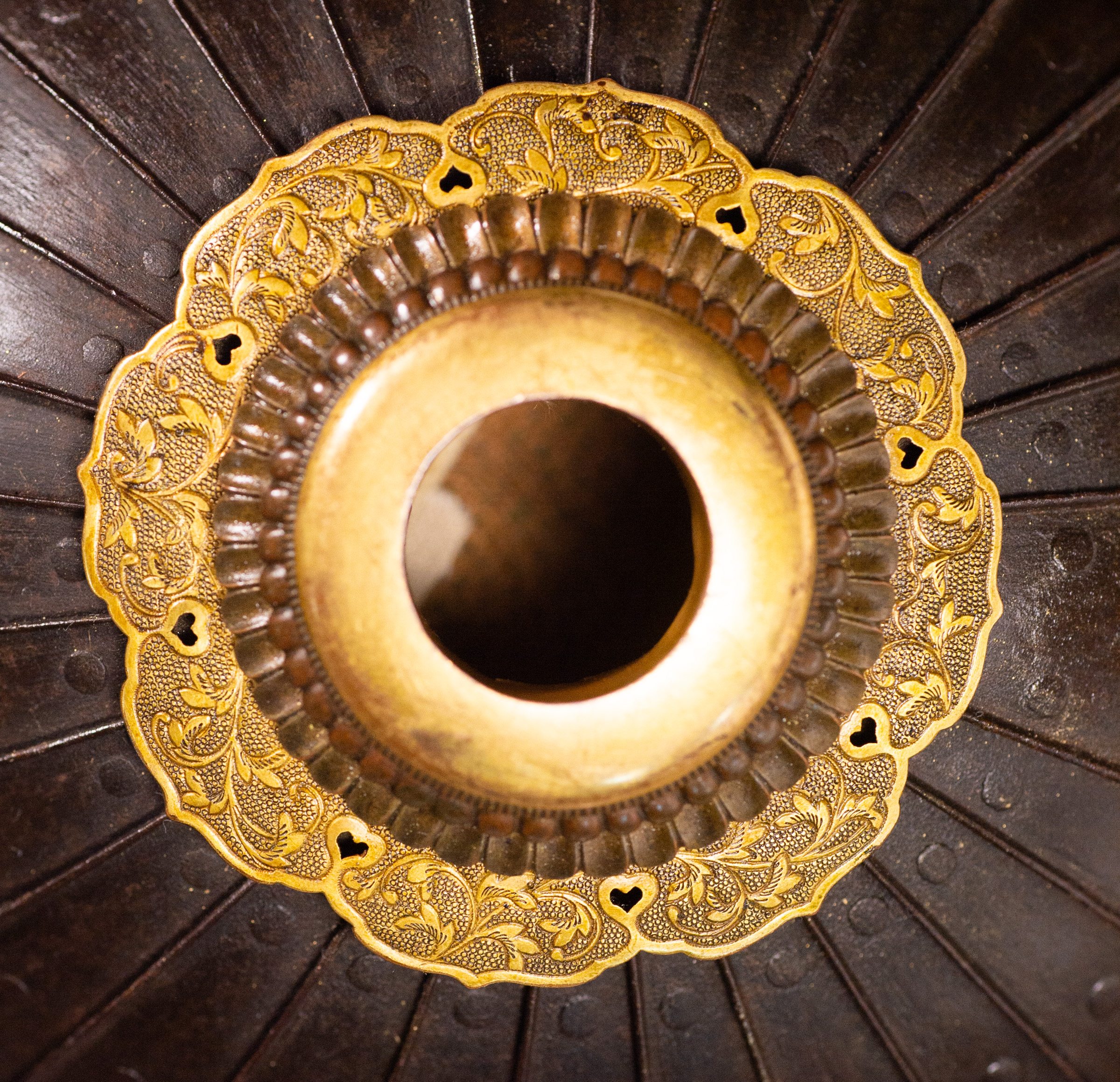
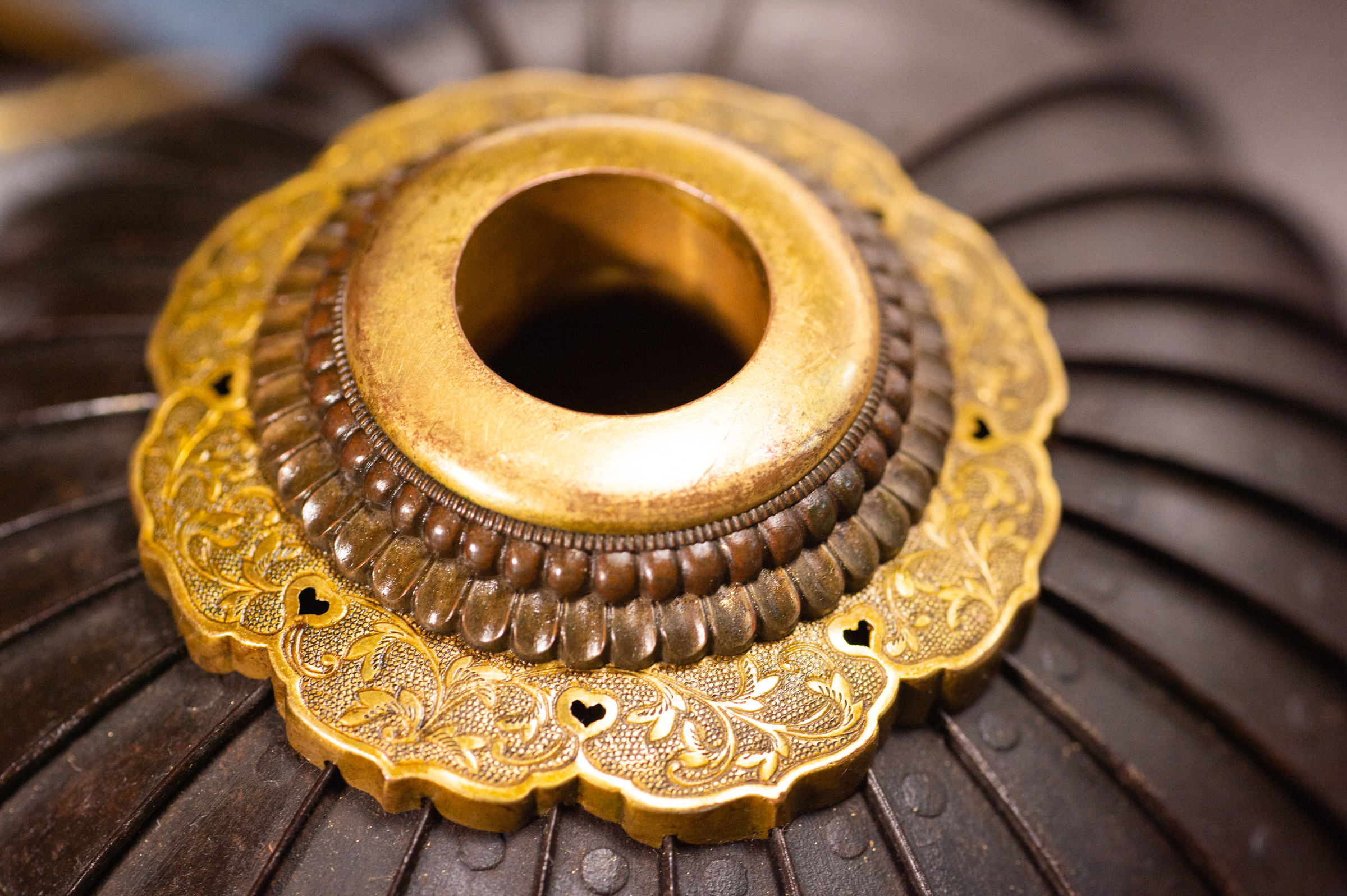
Remarkable tehen no kanamono, finely crafted with floral motifs in gilt metal, demonstrating sophisticated metalwork.
Large maedate in gilded metal, shaped as two stylized symmetrical bird-like forms, providing strong visual elevation.
Fukigaeshi lacquered in matching tones and decorated with the family mon (three stylized leaves within a hexagon), indicating clan identity.
Multi-plate shikoro with cords in olive green and ivory, harmonizing perfectly with the rest of the armor.
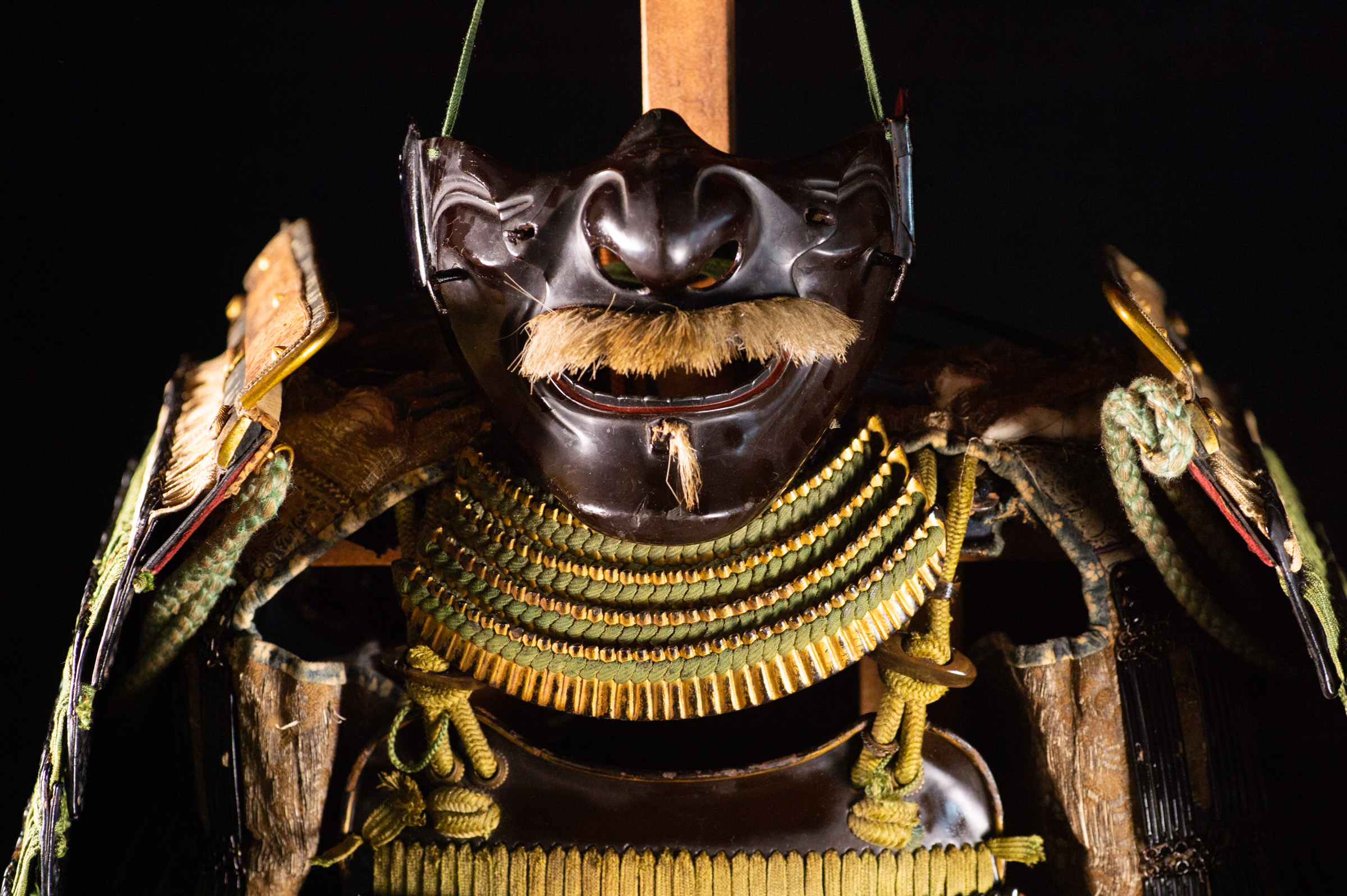
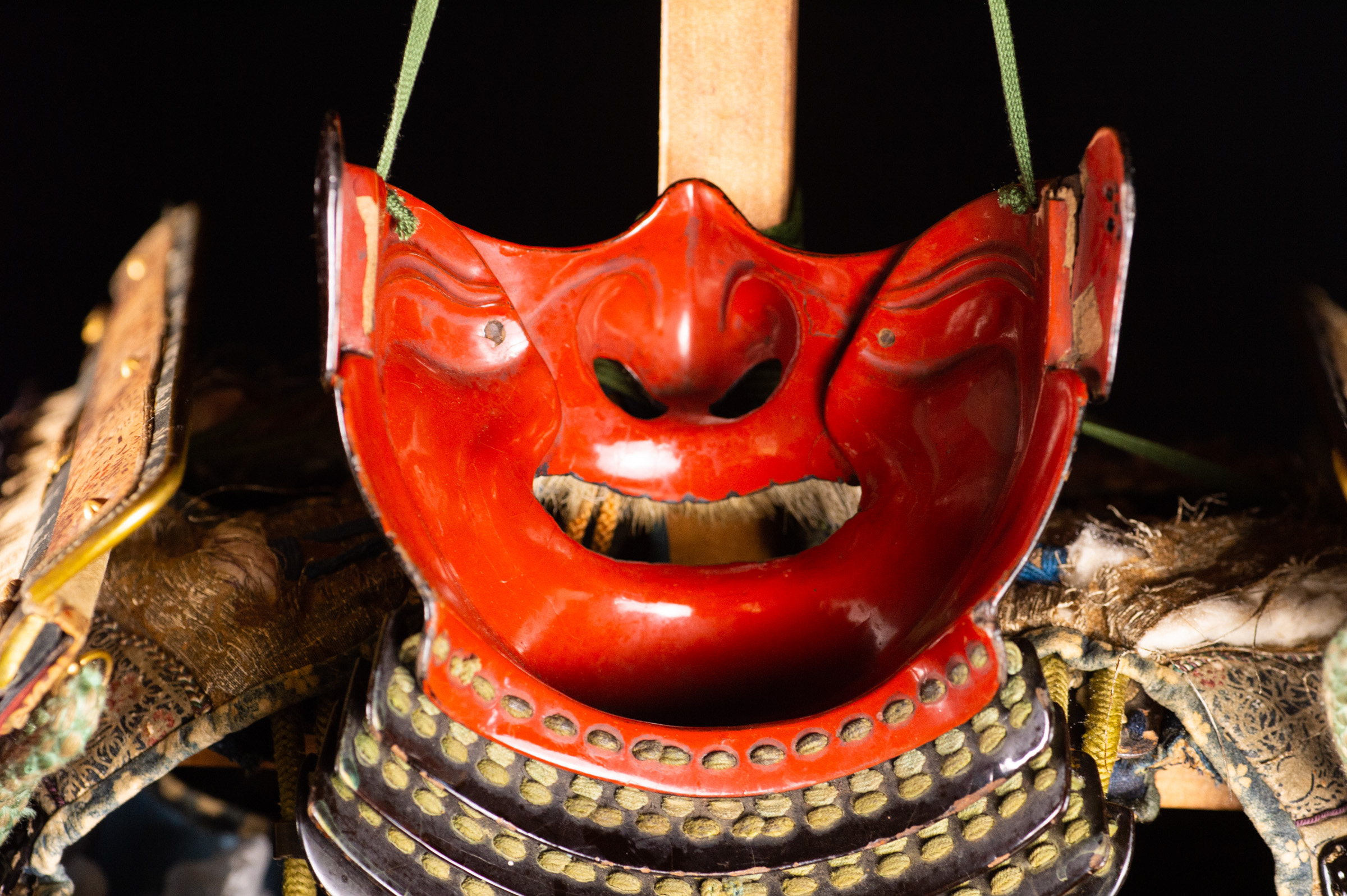
Menpō (Face Mask)
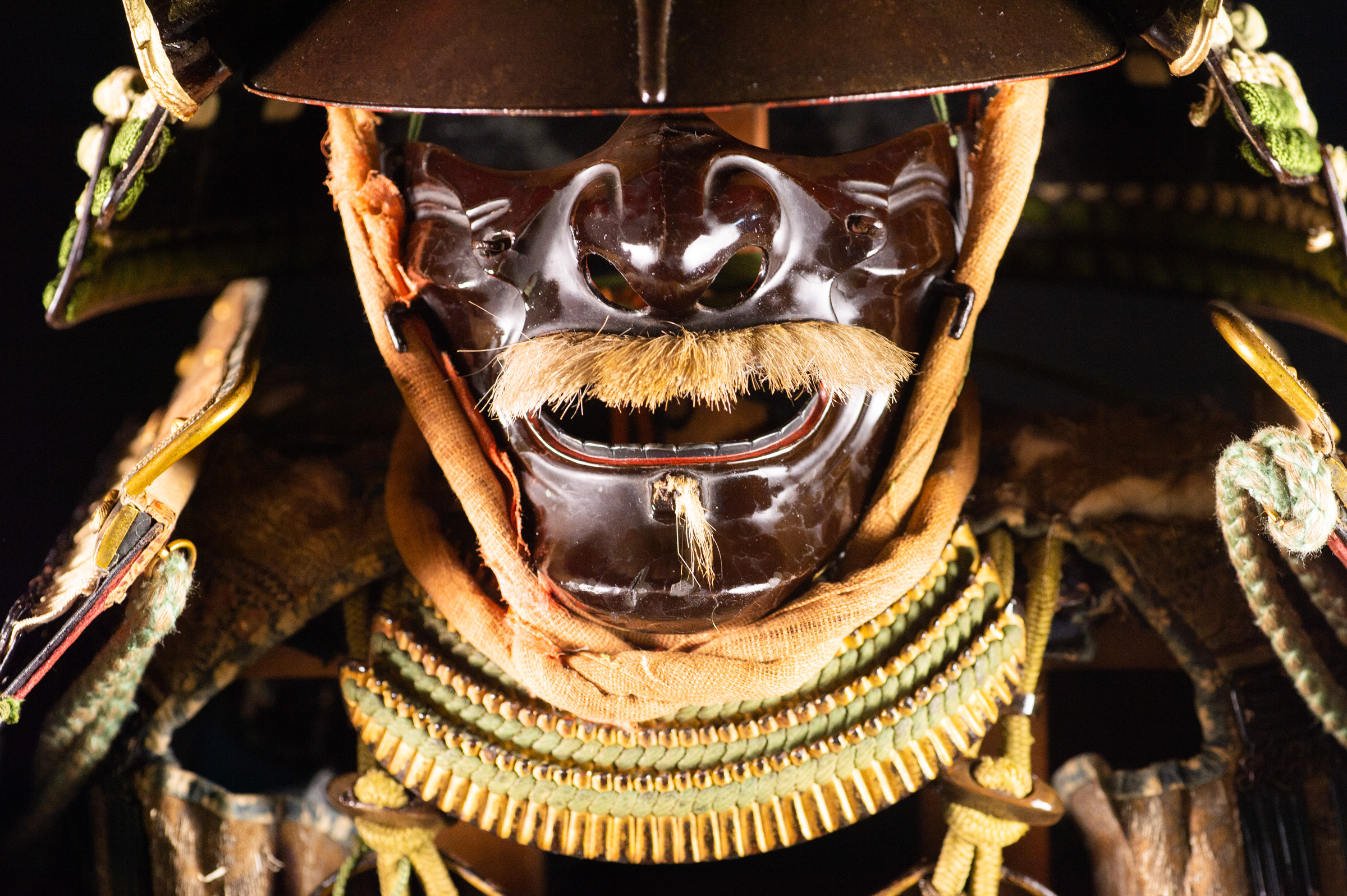
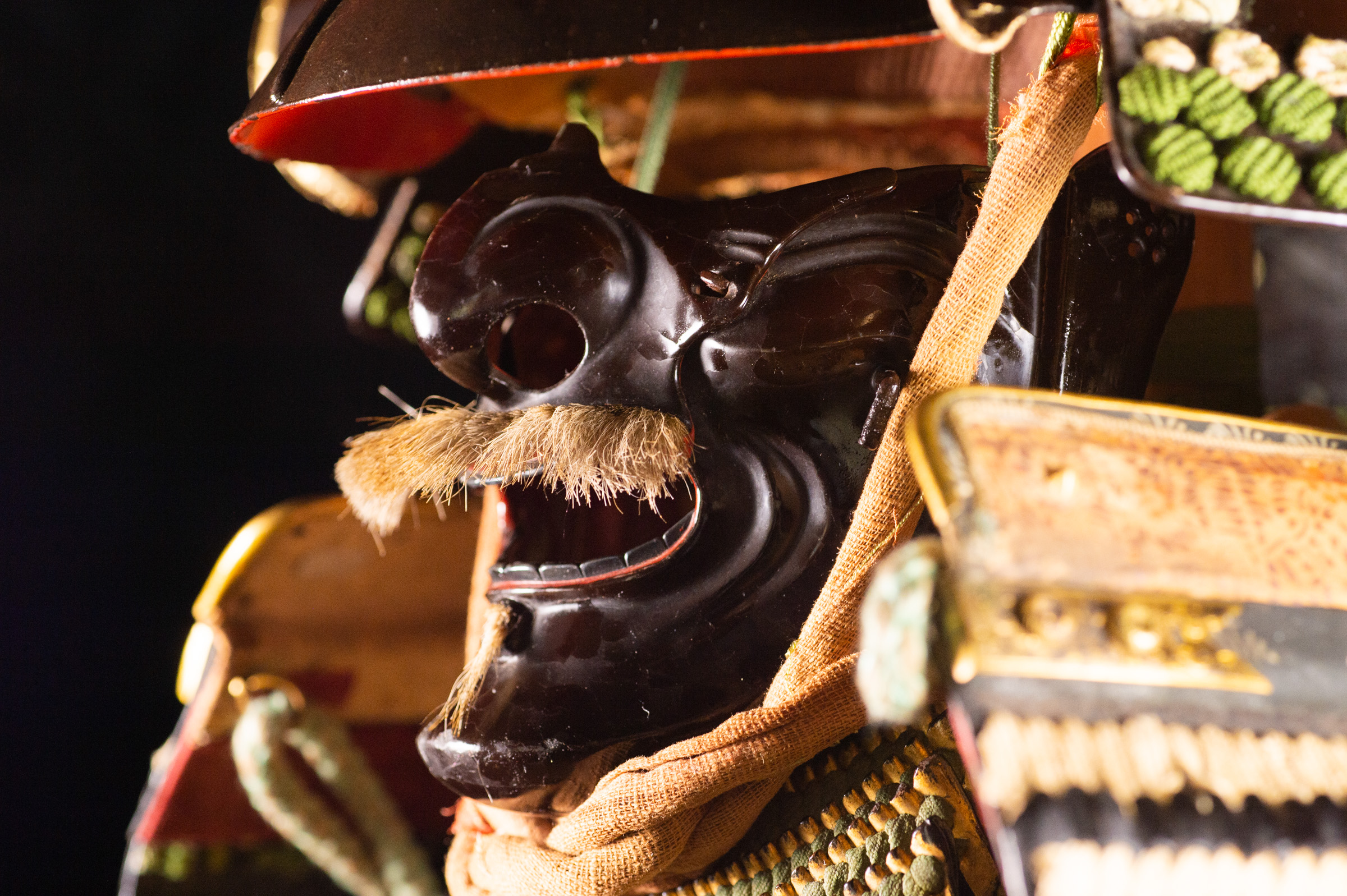
Lacquered in a deep, glossy brown.
Expressive open-mouth design typical of Edo-period face armor.
Natural-hair moustache and chin tuft, adding realism and intensity.
Original textile padding around the neck, showing age-consistent wear.
Dō (Cuirass) — Featuring Esoteric Buddhist Motif
Kozane-style construction with lacquered scales in a deep brown tone.
Decorated with numerous golden hoshi (studs) arranged in regular patterns.
Prominent central metal ornament representing a stylized kongō-sho (vajra): two open pointed ovals connected by a ribbed central grip.
Symbolism: the vajra expresses indestructibility, spiritual authority, and protective power, serving as a talismanic centerpiece.
Additional side metal ring (kan), commonly found in certain Edo ceremonial cuirasses.
Cords in yellow and olive tones reinforcing the harmony of the ensemble.
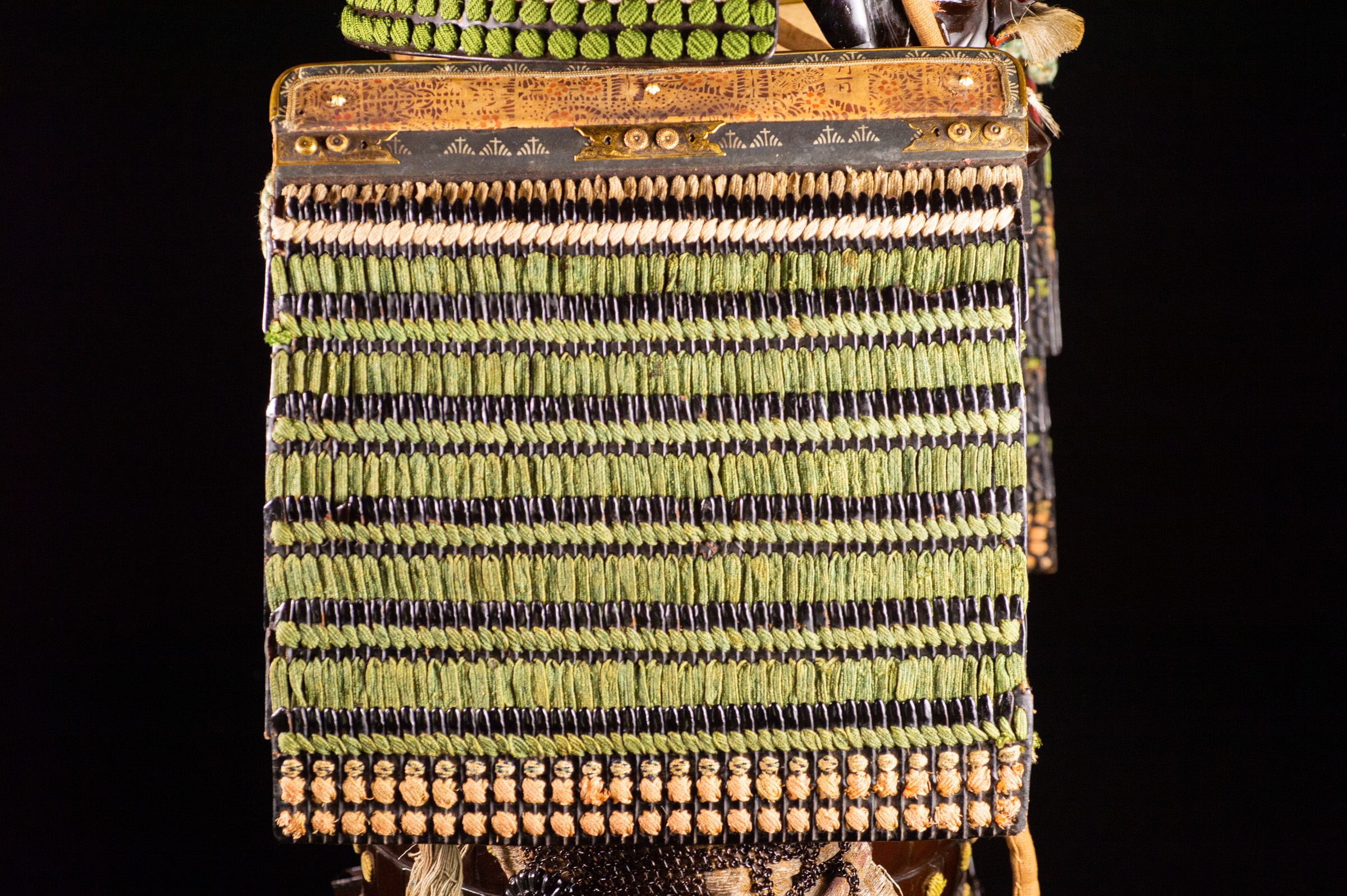
Sode (Shoulder Guards)
Large, imposing sode built from multiple lacquered lames.
Lacing in green, ivory, and yellow tones.
Excellent visual balance with the kabuto and dō, reflecting uniform workshop execution.
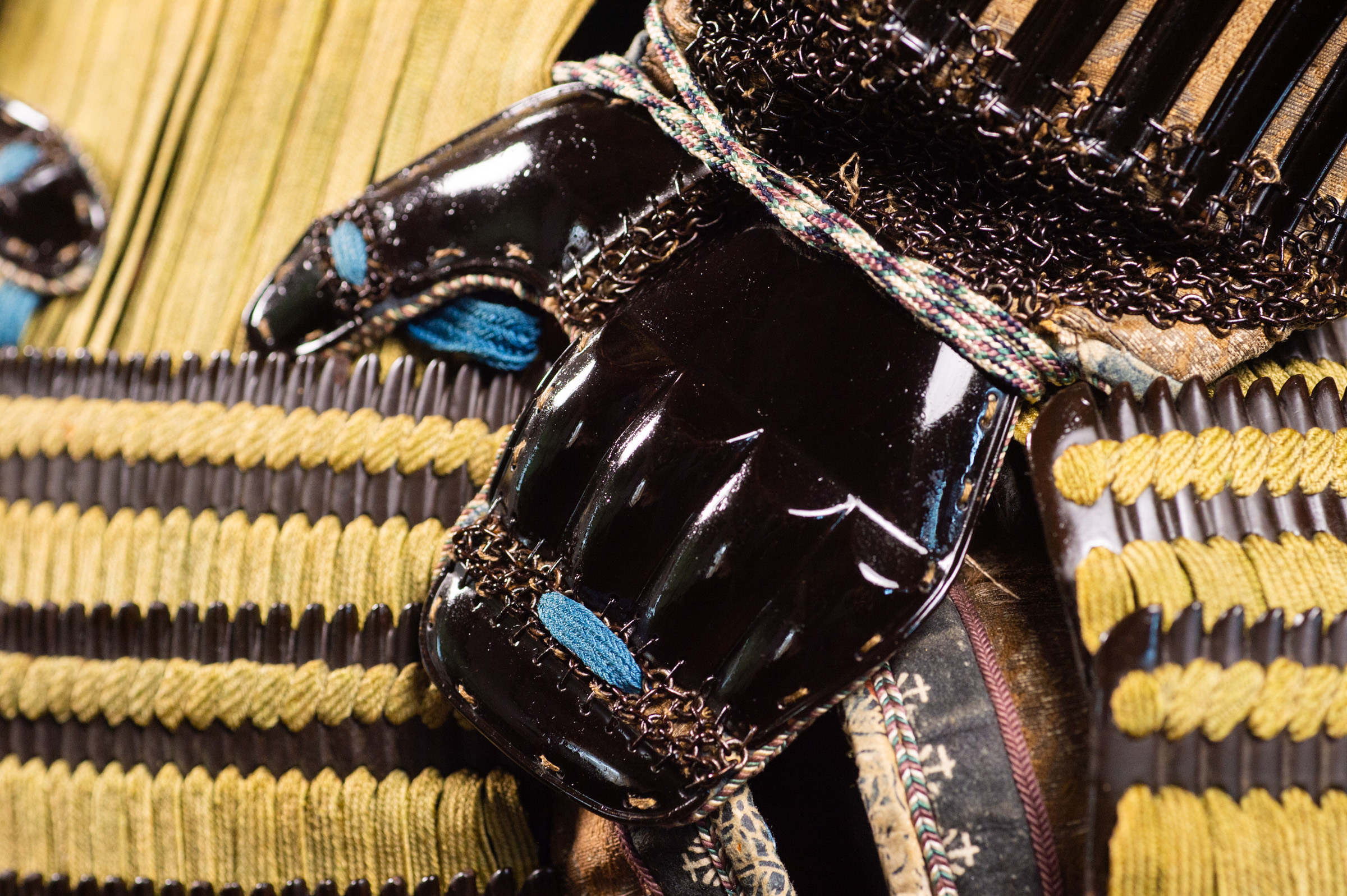
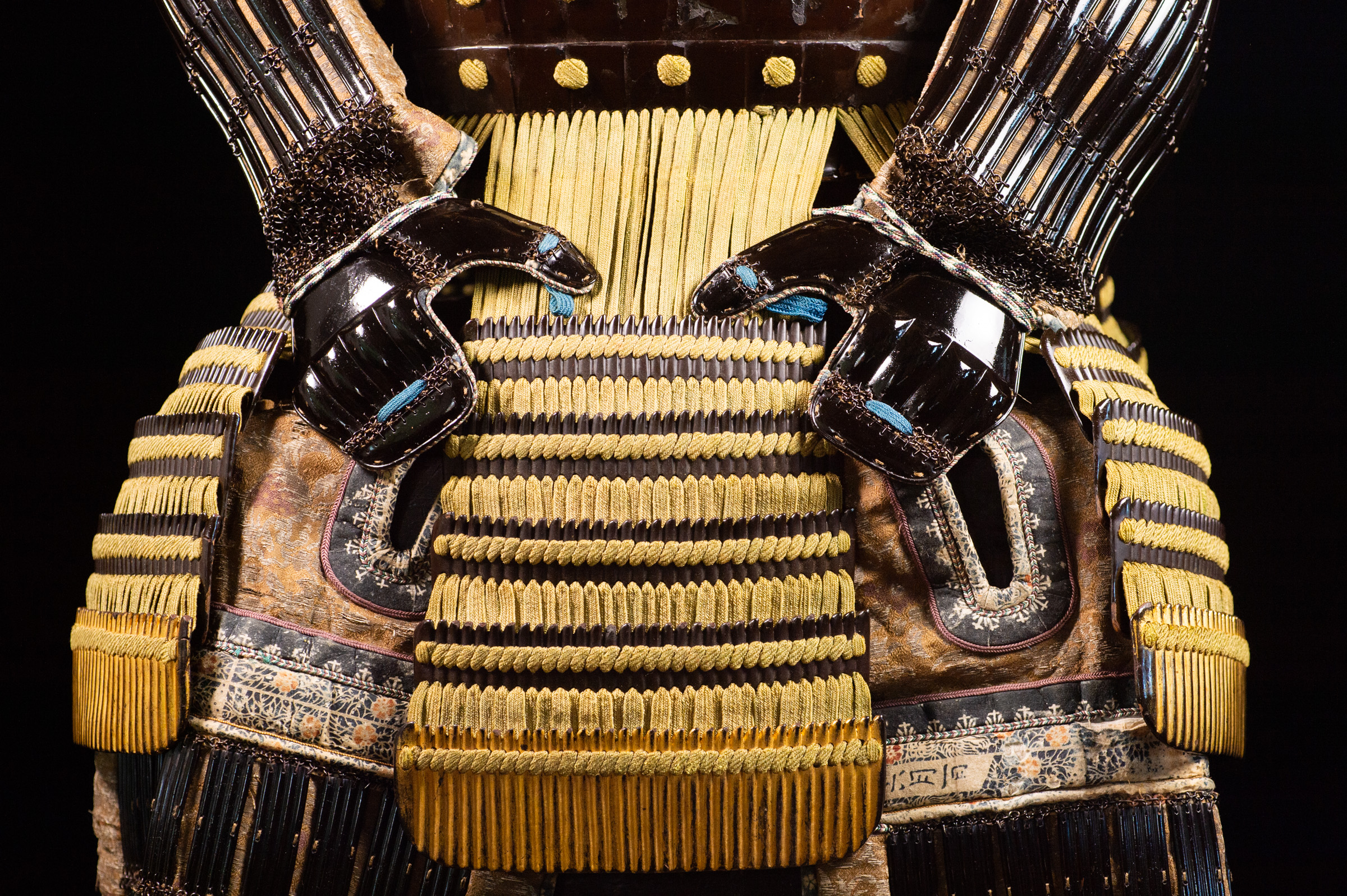
Kote (Armored Sleeves)
Constructed with black lacquered plates interconnected with kusari (chainmail).
Textile components worn but intact and structurally sound.
Plates showing stable patina without structural compromise.
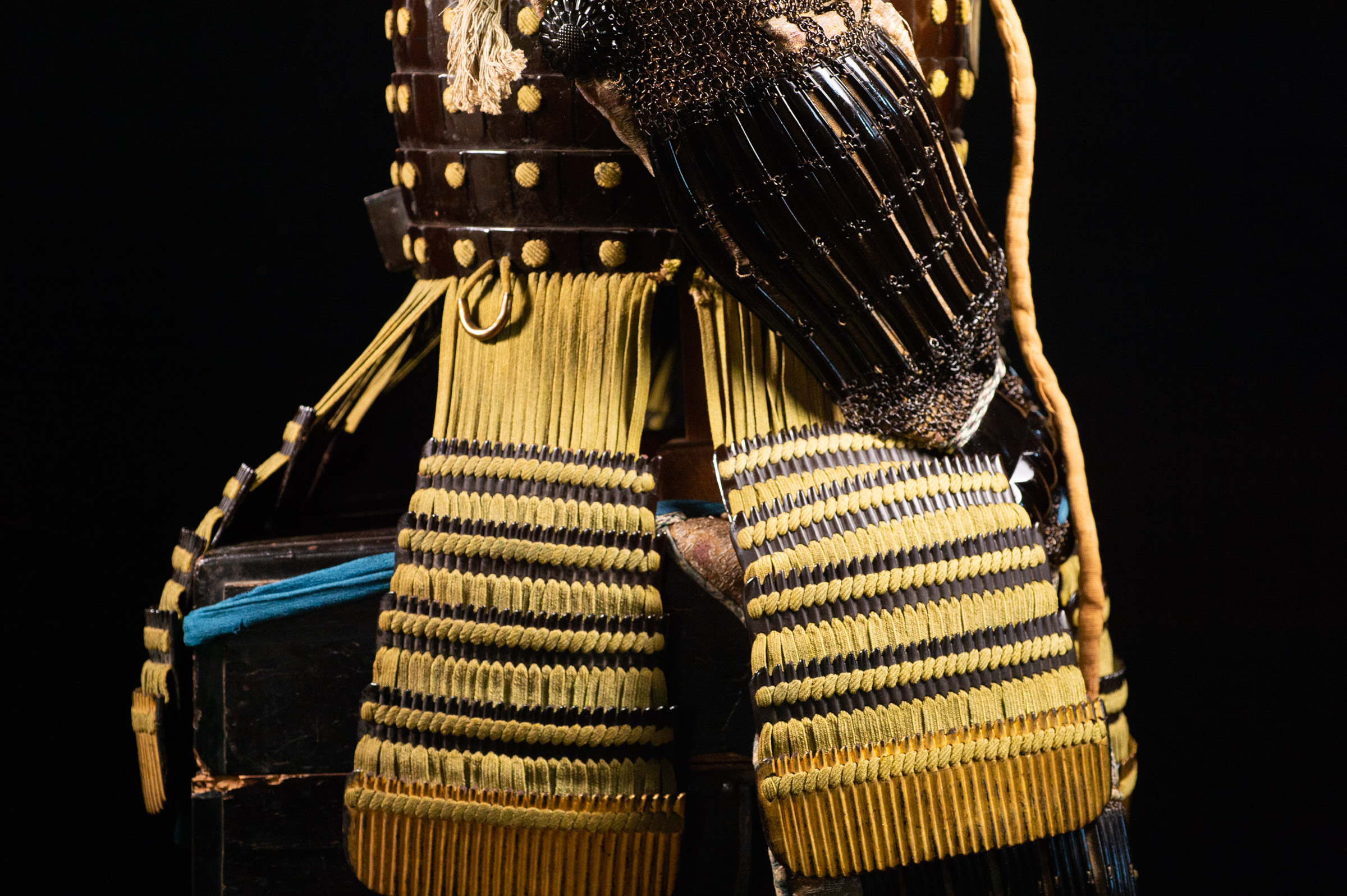
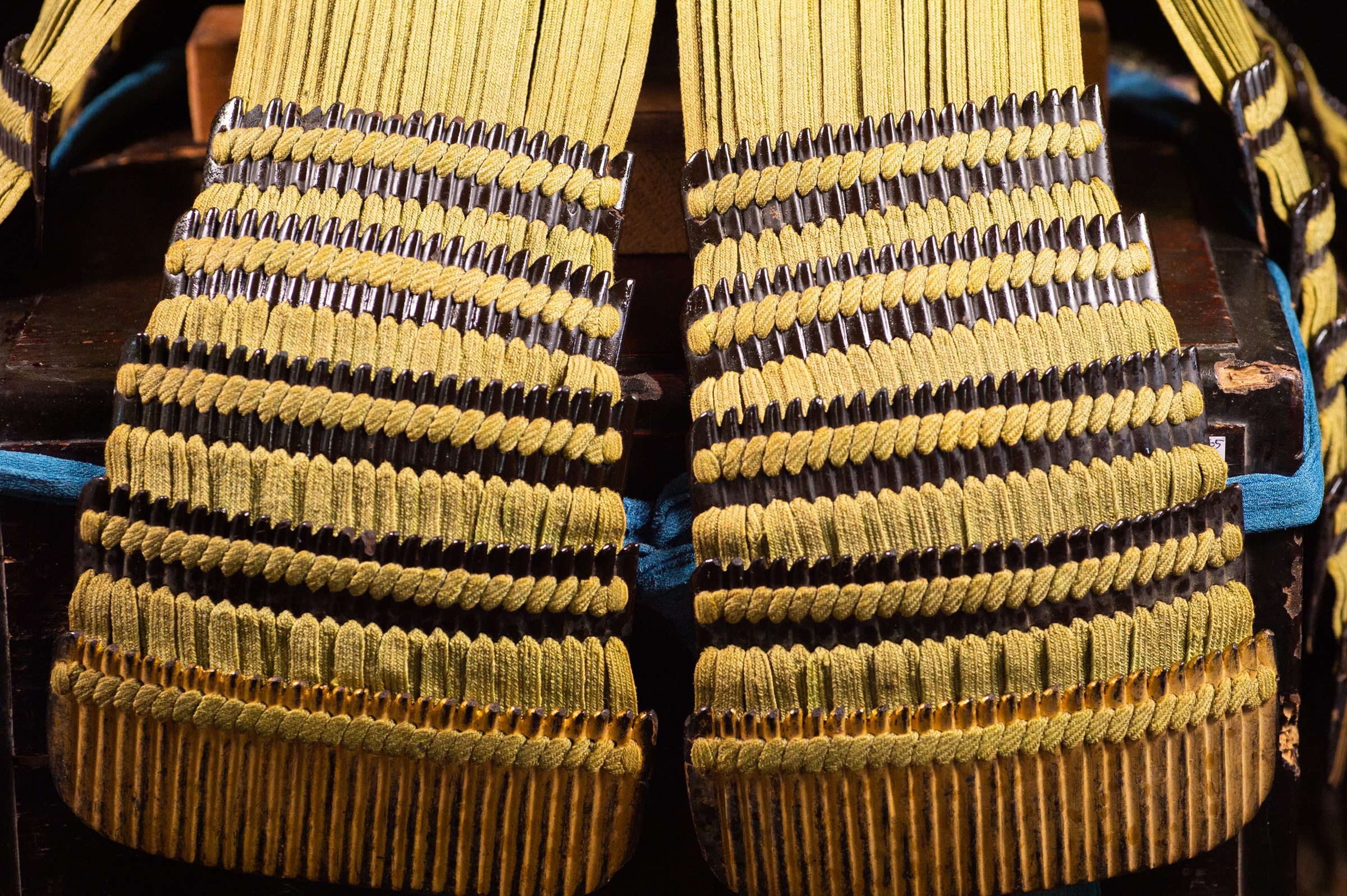
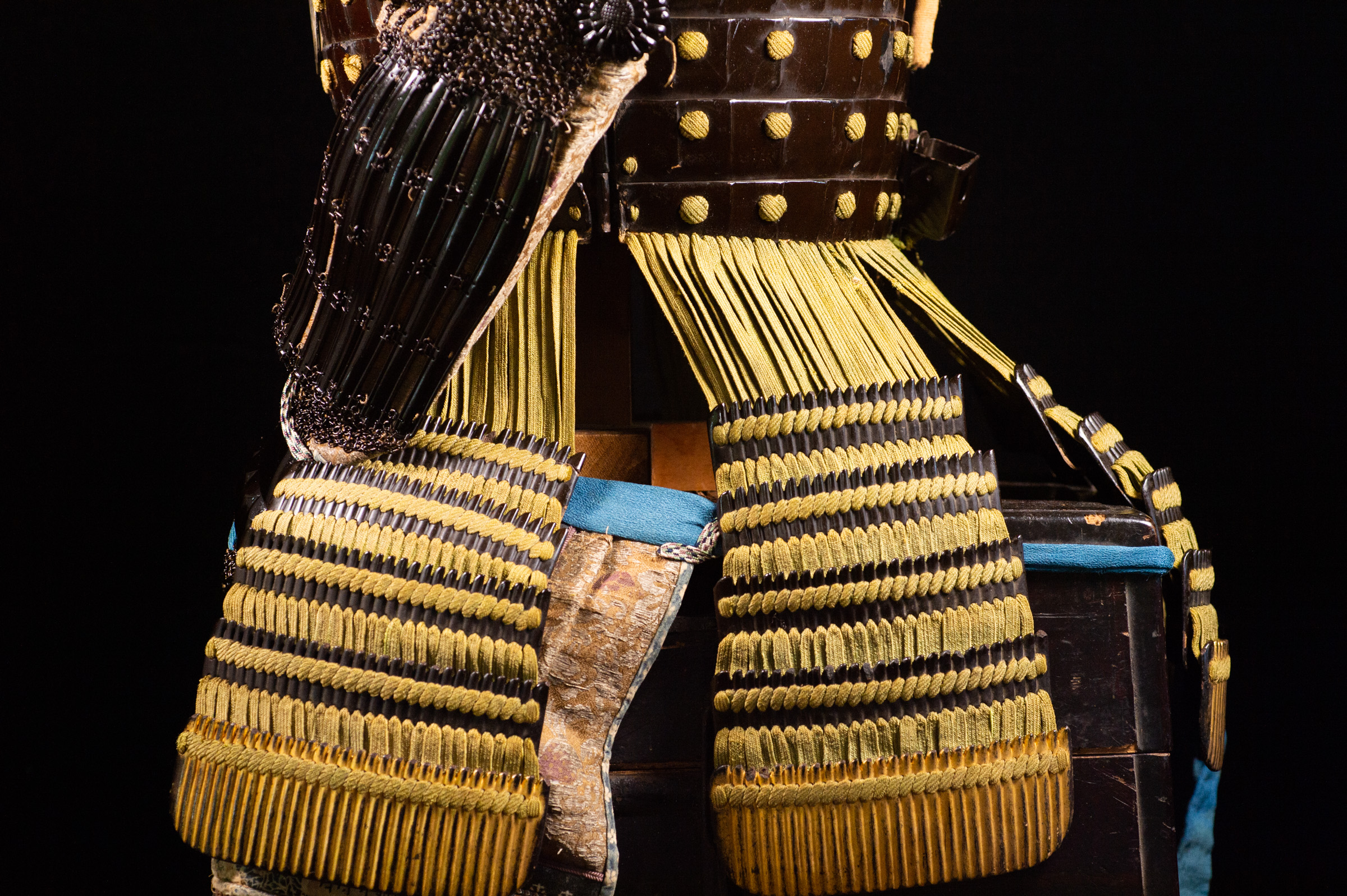
Haidate (Thigh Guards)
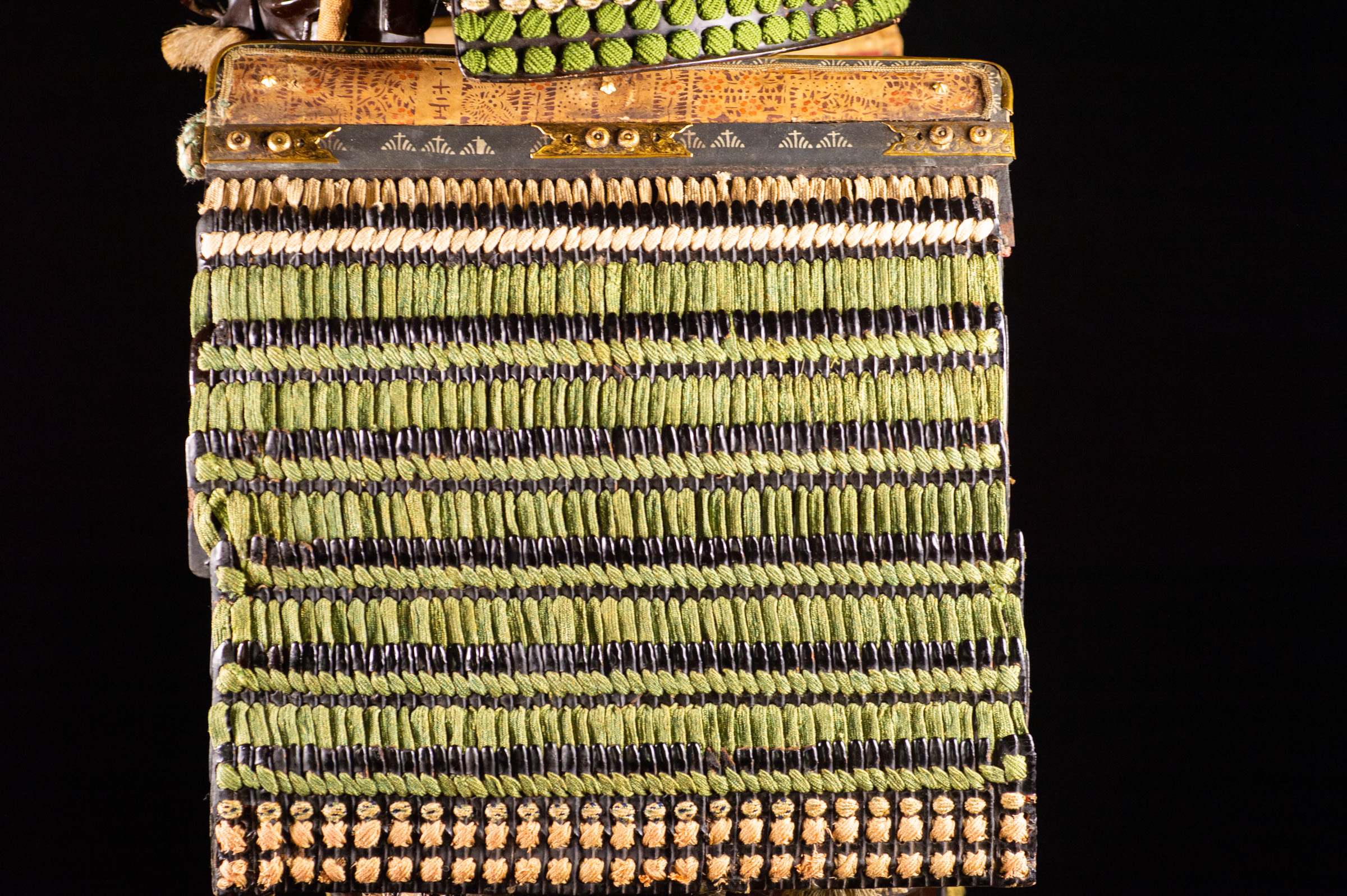
Composed of multiple lacquered strips in black and yellow.
Upper area decorated with patterned textiles featuring floral and geometric designs.
Maintains full coherence with Edo-period materials and construction.
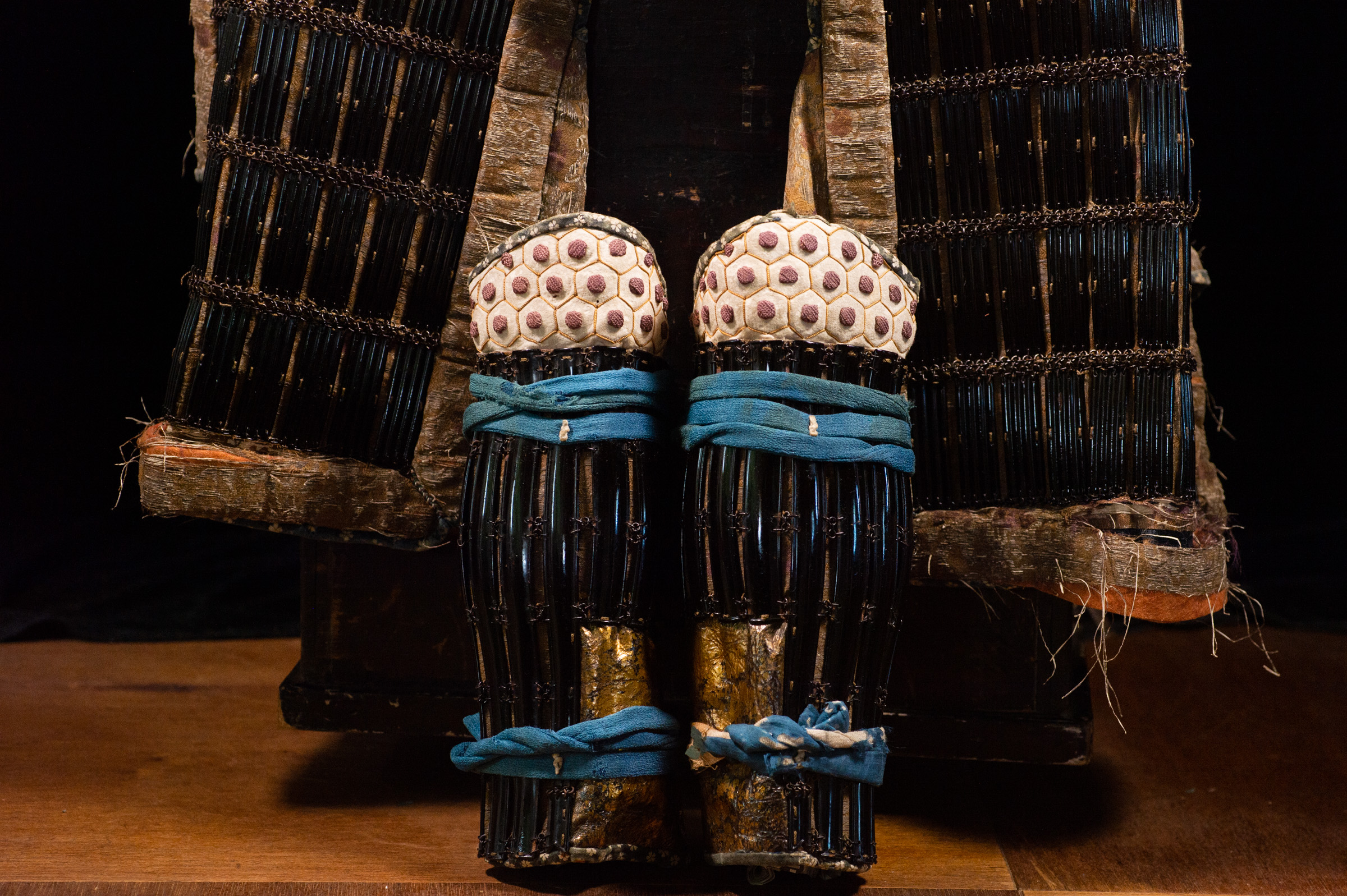
Suneate (Shin Guards)
Lacquered black tubular plates with excellent patina.
Upper padding in kikkō (hexagonal) pattern, a classic motif of prestige and protection.
Bound with light blue cords showing appropriate age-related wear.
Condition
Consistent and cohesive Edo-period patina throughout.
Lacquer largely well preserved with expected small areas of wear.
Textiles show natural ageing but remain structurally solid.
All components exhibit authenticity in materials, lacquer, metalwork, and construction.
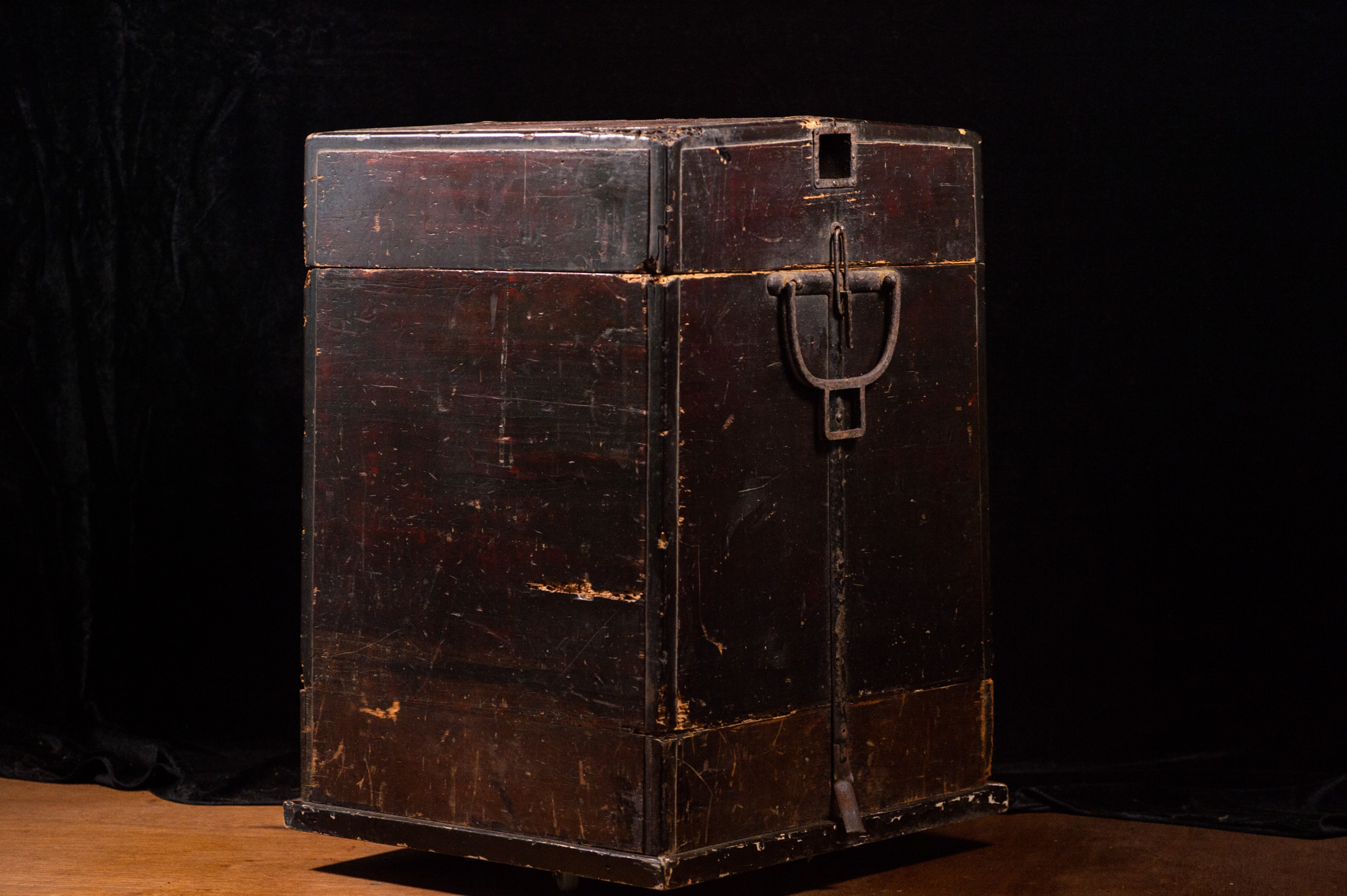
An authentic samurai armor that will be the central focus of any room where it is placed and that will delight any fan of Japanese art. This exclusive piece is making it an incredible opportunity for any collector of Japanese, war or simply historical art to get their hands on a piece that will attract attention wherever it is displayed, from offices, to private homes, offices or restaurants and will give a regal look to any place. The armour has gilded details that show the quality of the piece. The incredible workmanship accentuates such ornate pieces as the kabuto, the mempo and the Do. The stand to assemble it and the box are included. This armour is sure to delight any collector of Asian art and will be the focal point of any visitor’s home, shop or office. There is a very ancient object and there are damaged by time and tears. Due to the delicacy of continuous assembly and disassembly, returns are not allowed on old armor.


