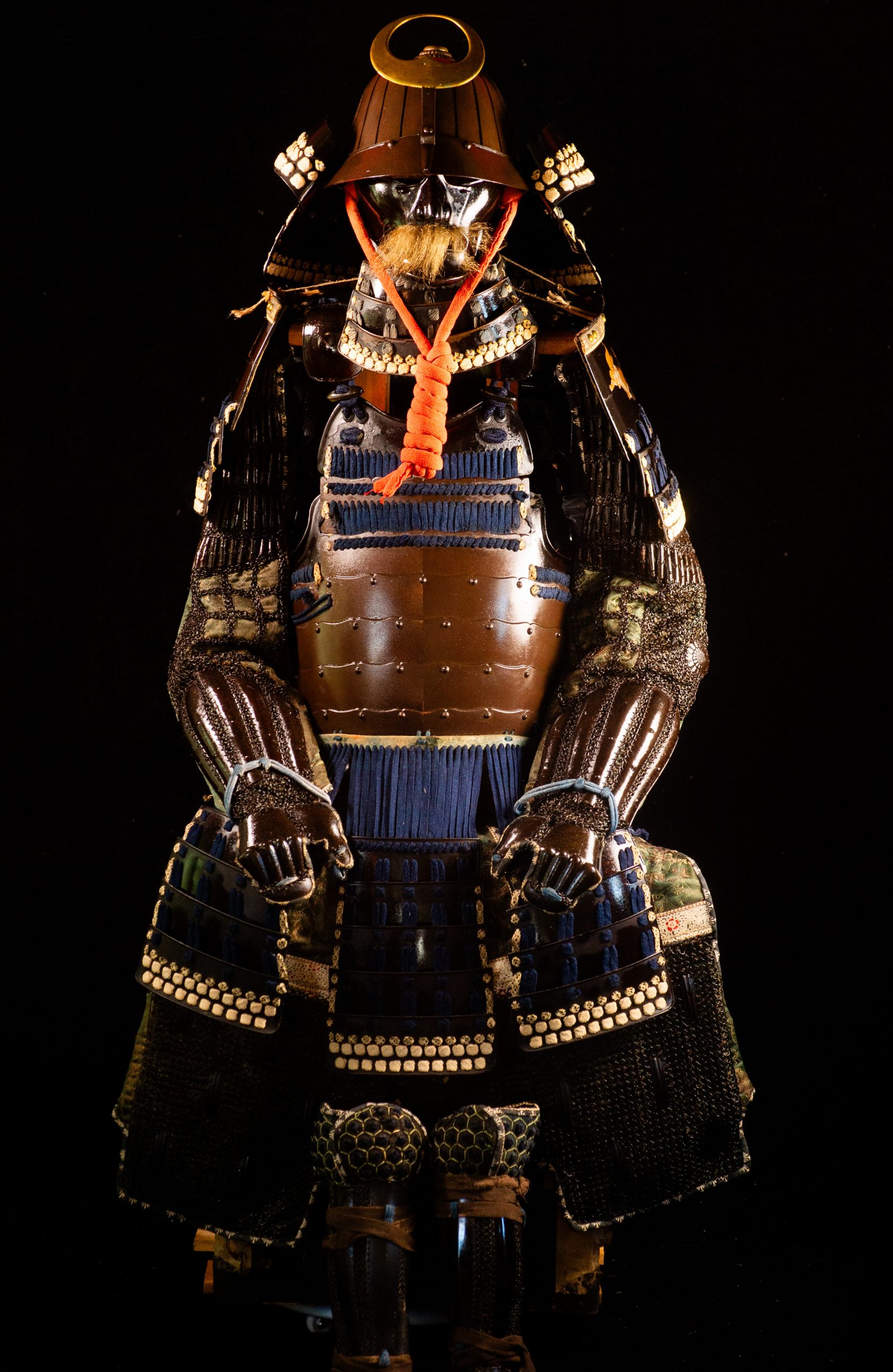
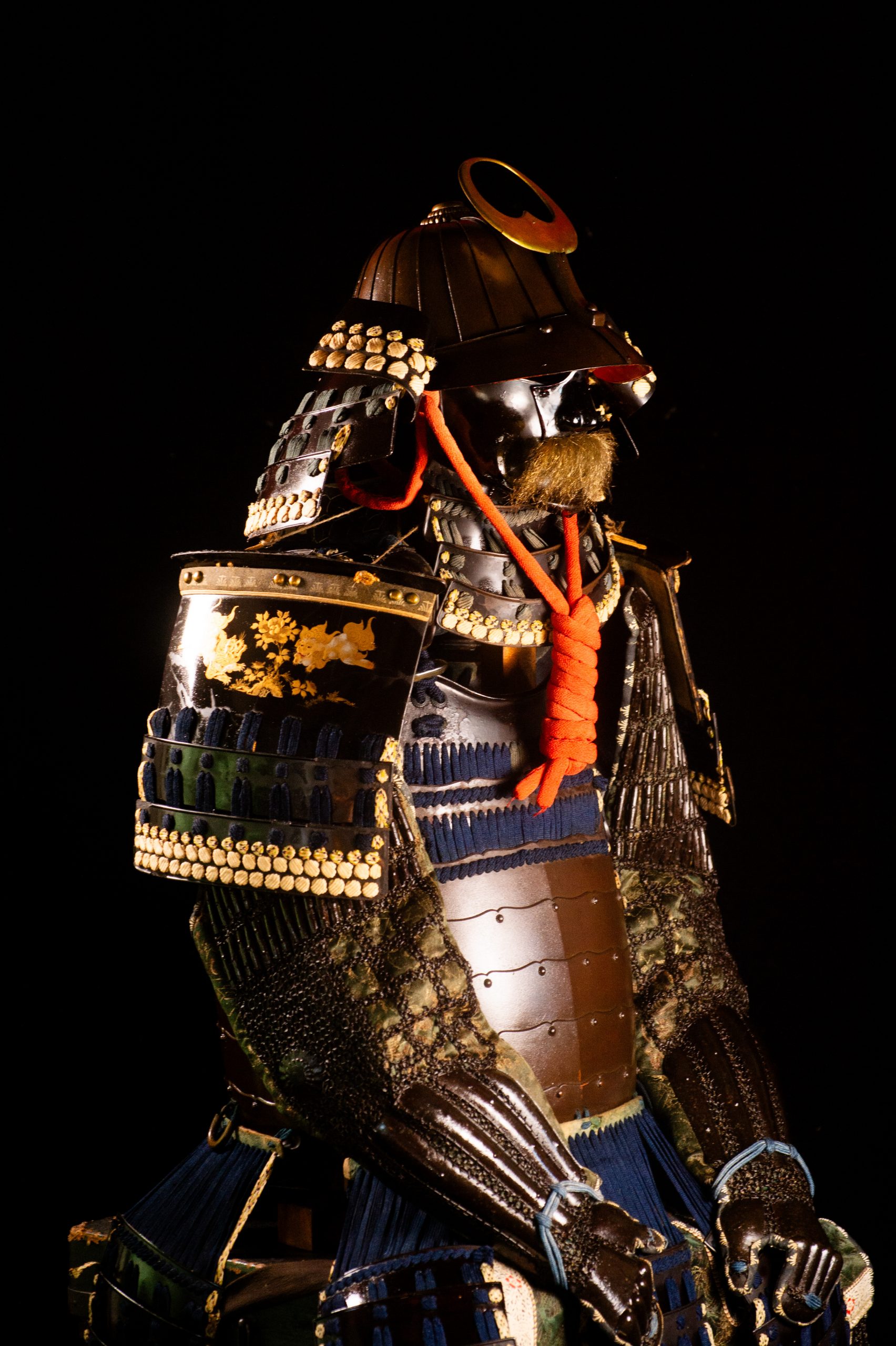
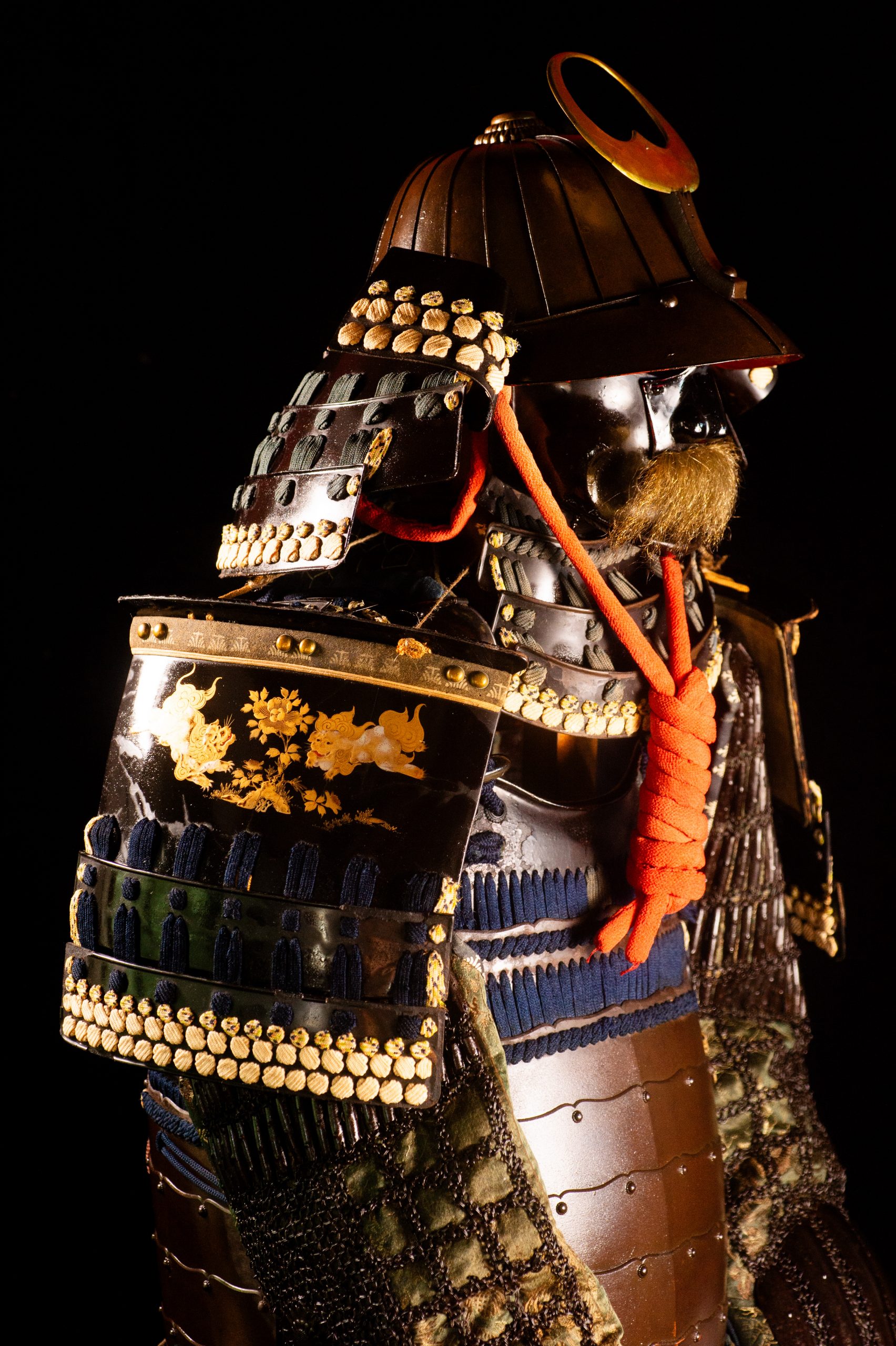
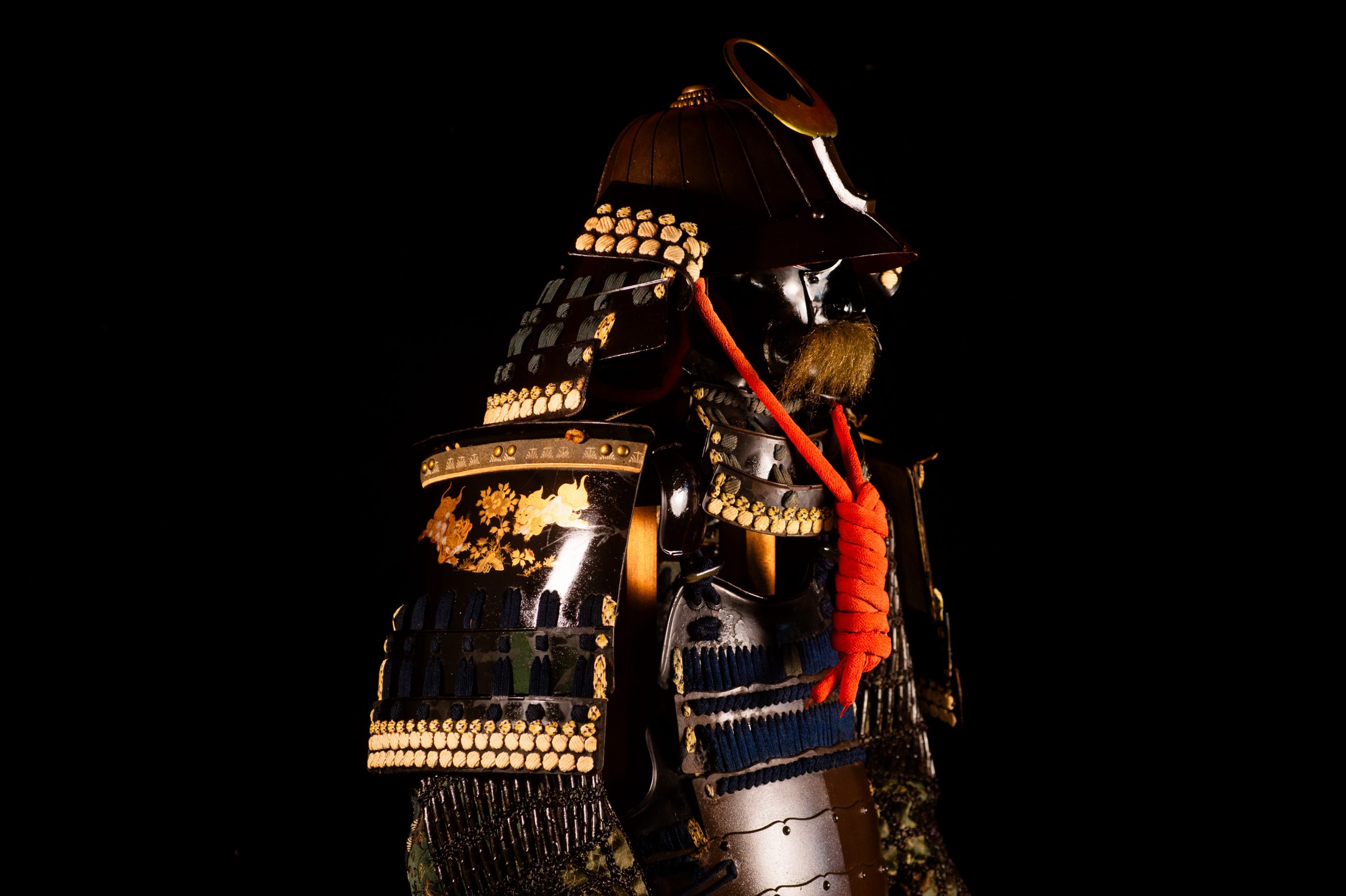
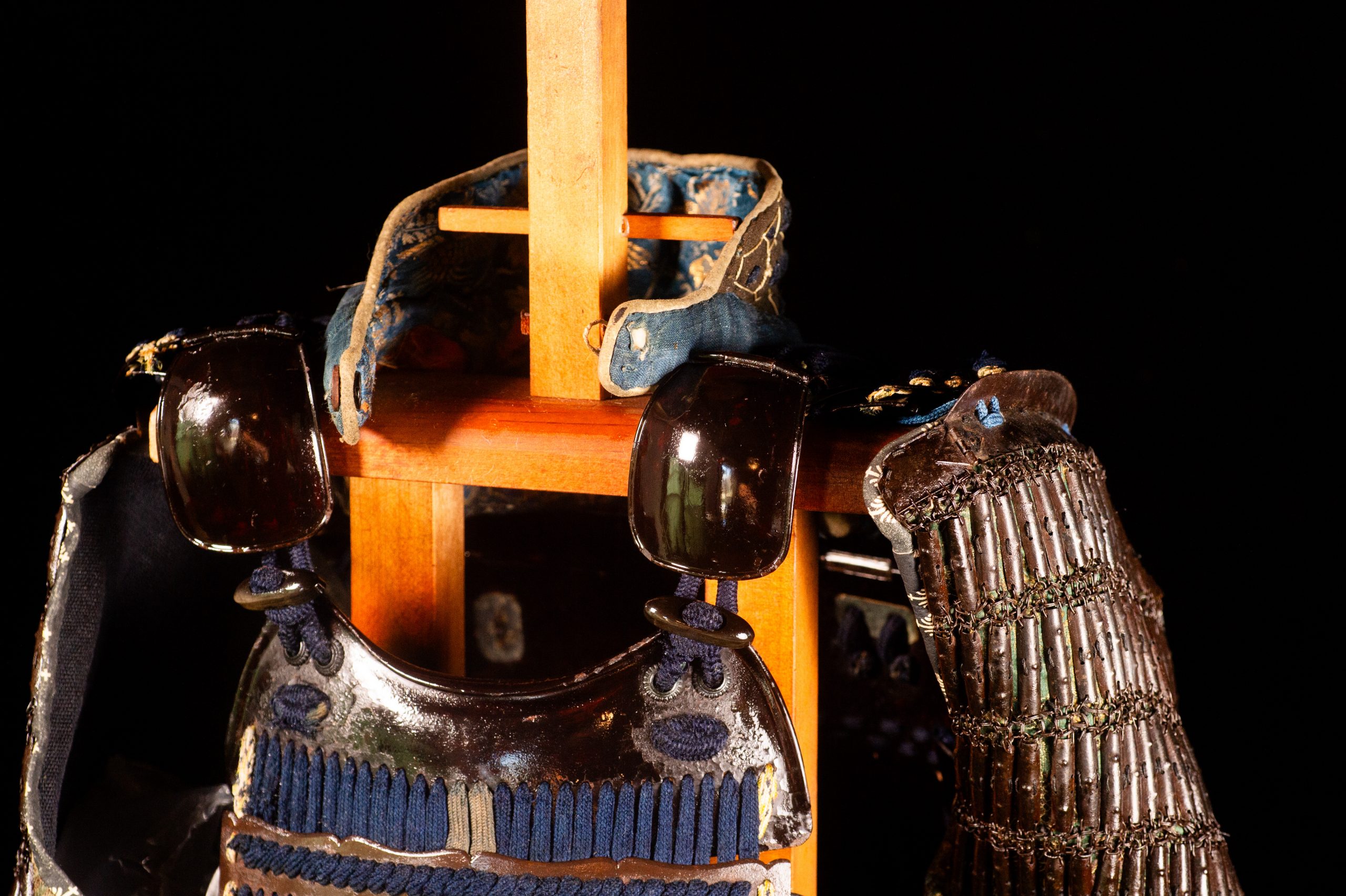
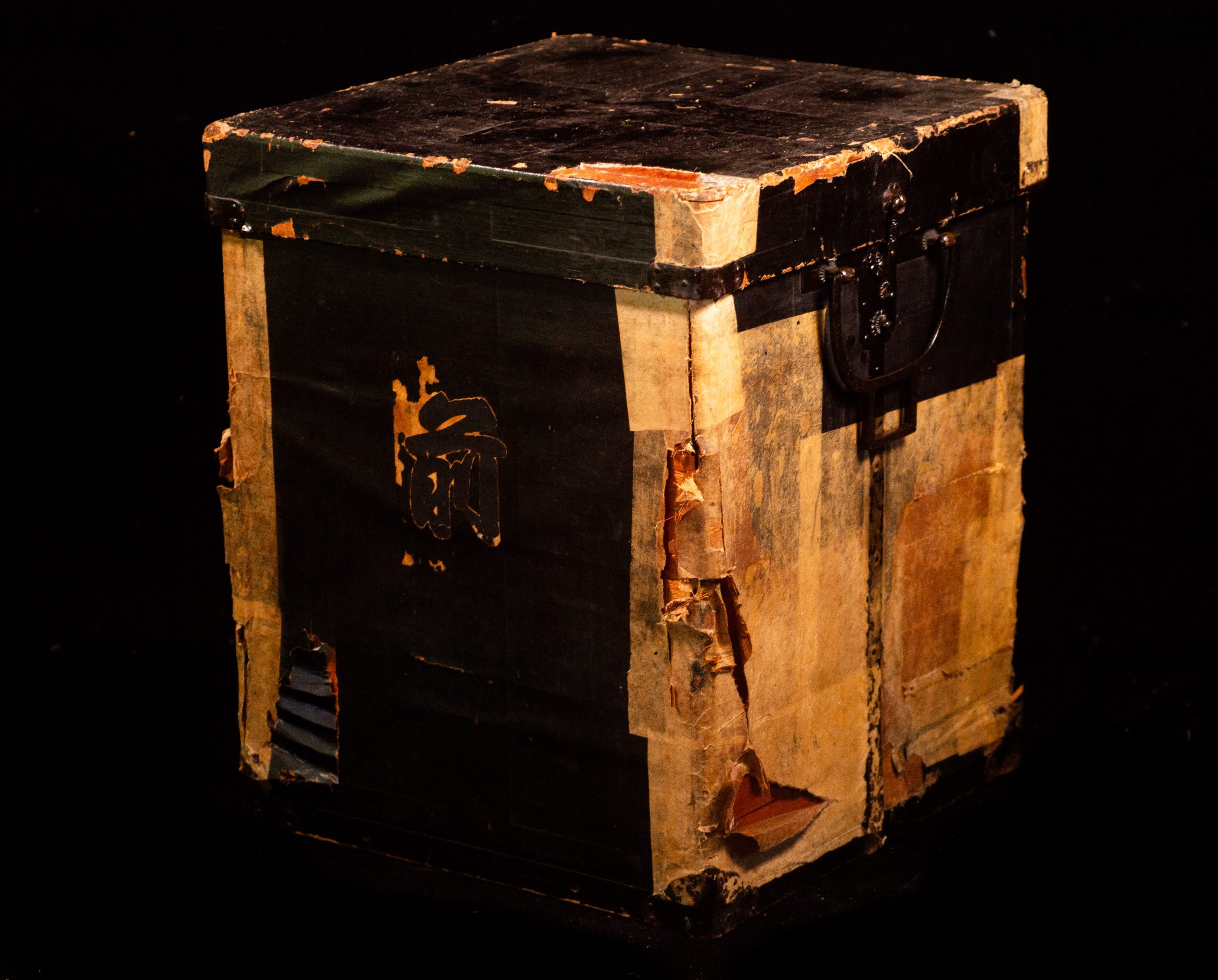
Japan, complete tōsei gusoku armor, Edo period (circa s.XVIII)
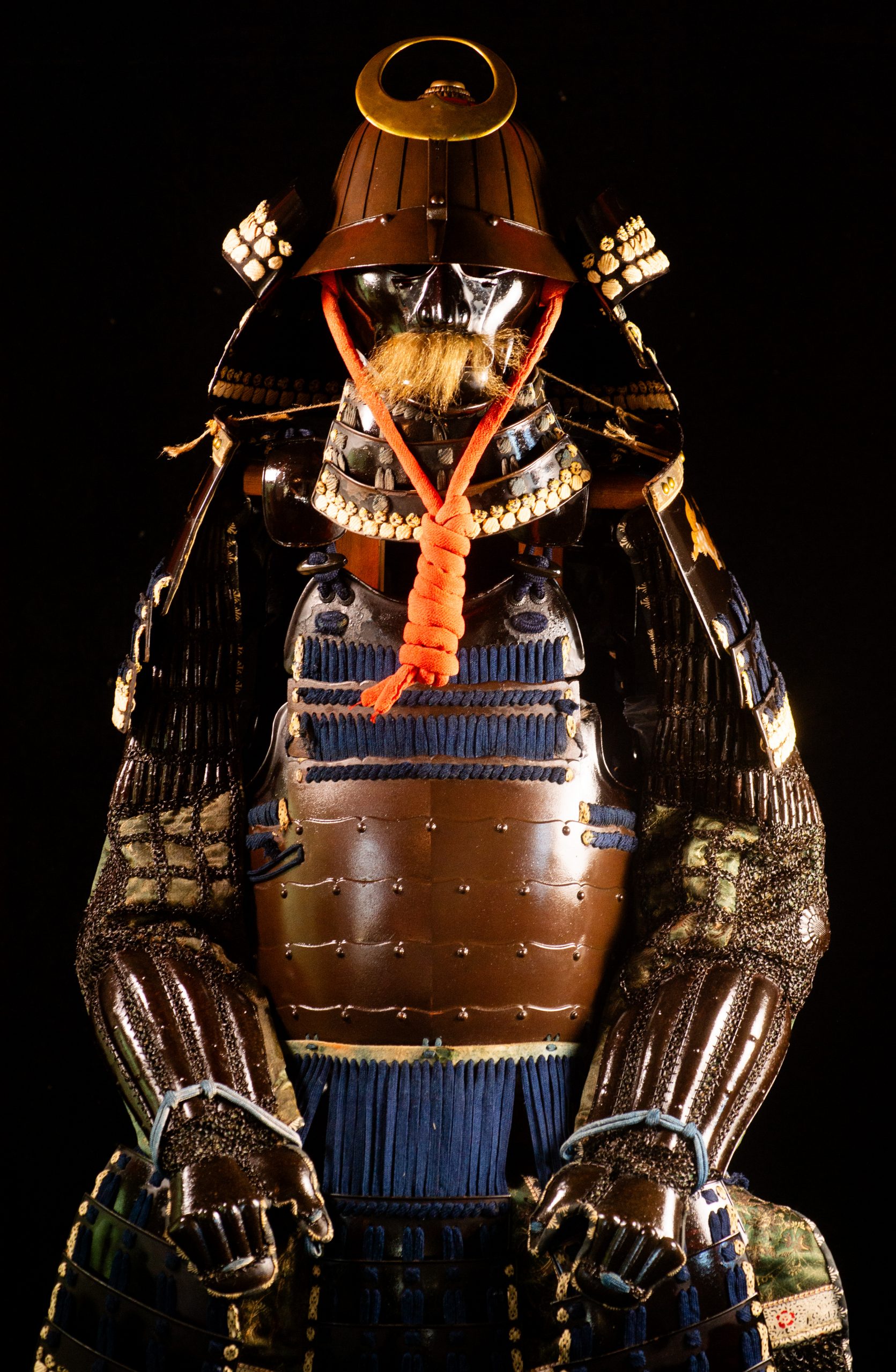
A highly impactful armor set defined by deep dark lacquer and a deliberate color contrast: blue odoshi lacing, a vermilion-red tying cord at the front, and gilt accents that sharpen the silhouette. The ensemble reads as a tōsei gusoku with a distinctly martial character, yet with clear “dress” elements—most notably the maki-e decoration on the sode and a bold gilt maedate that gives the helmet immediate presence.
Technical breakdown by components
Kabuto (helmet)
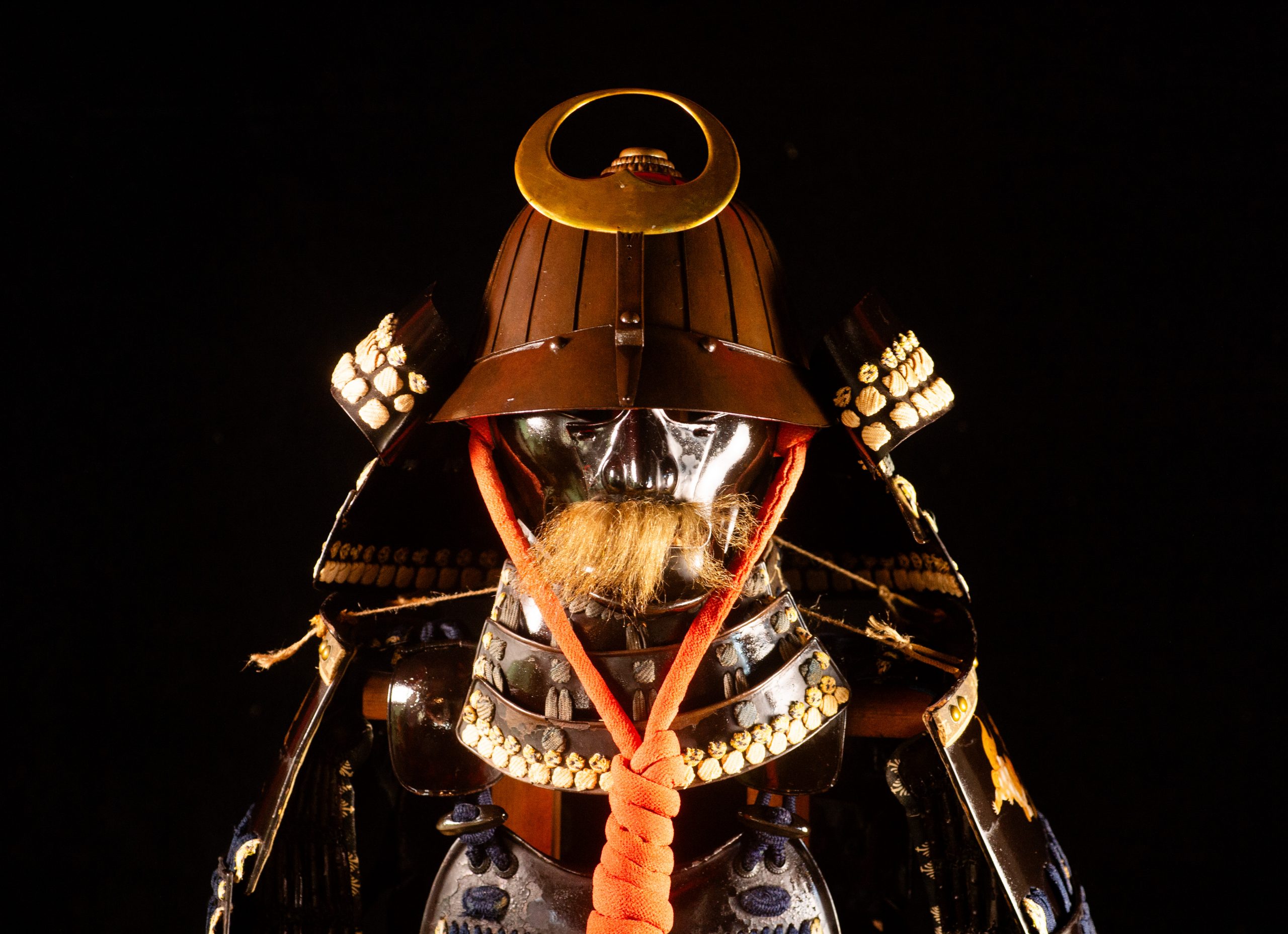
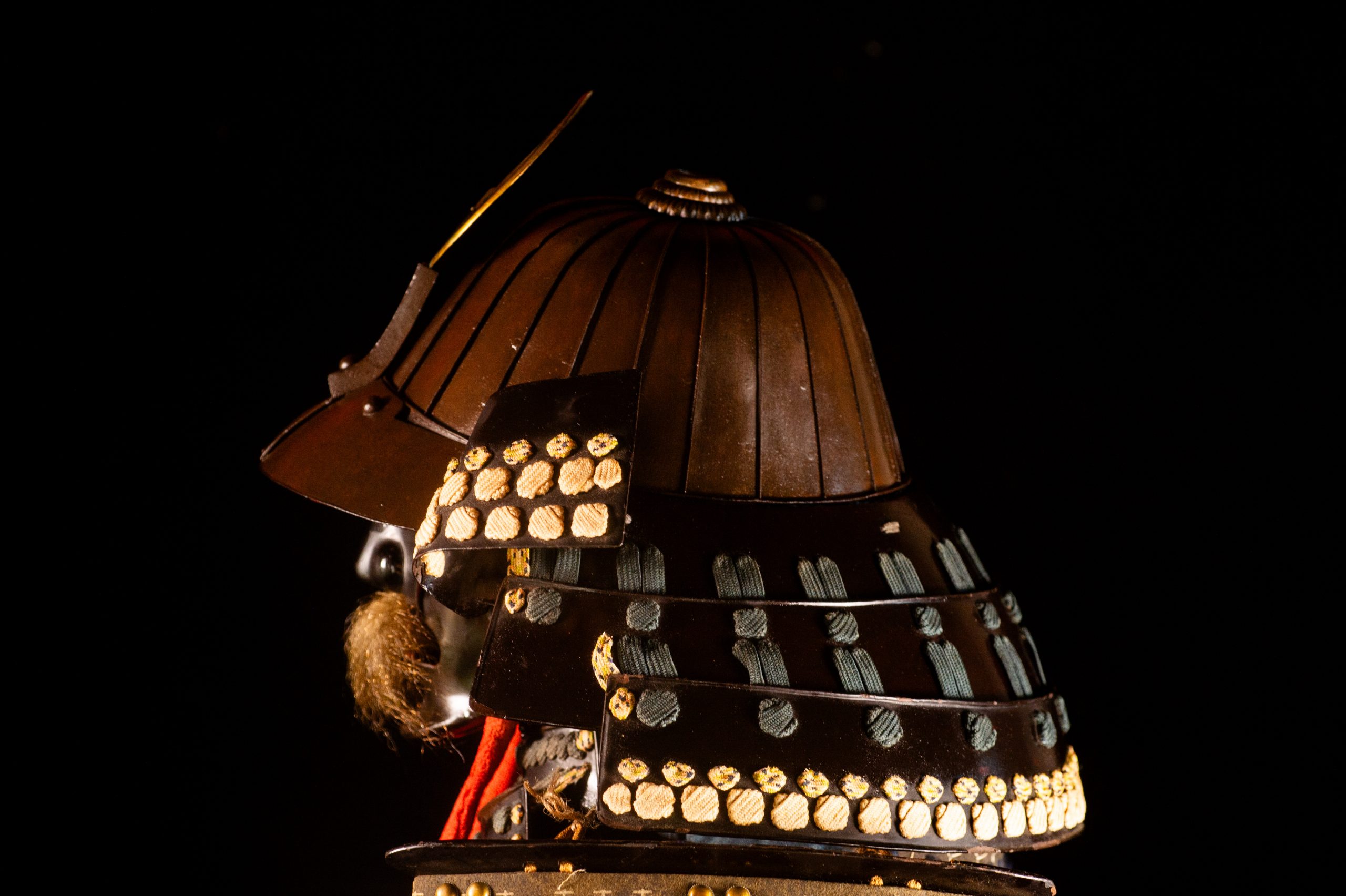
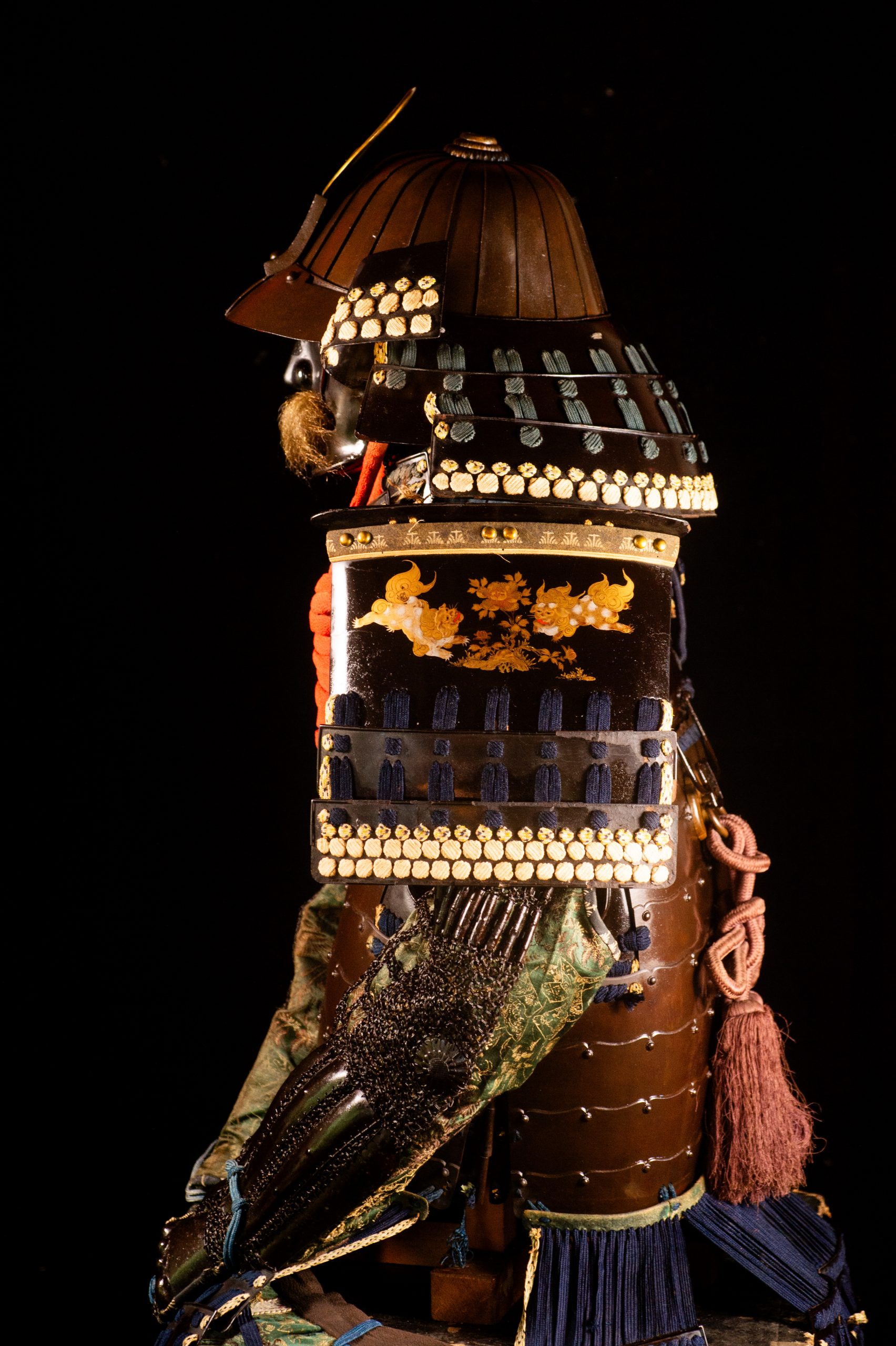
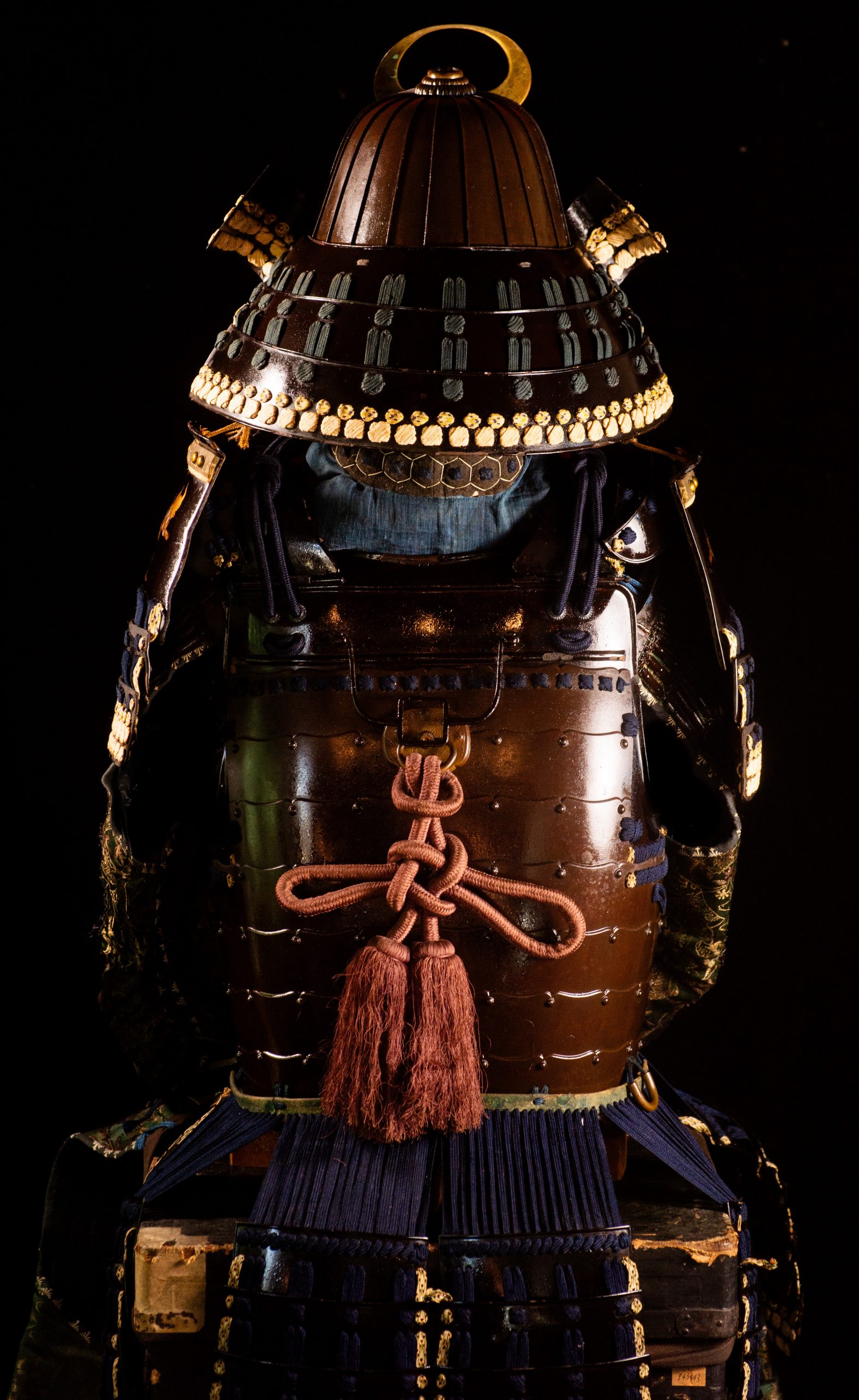
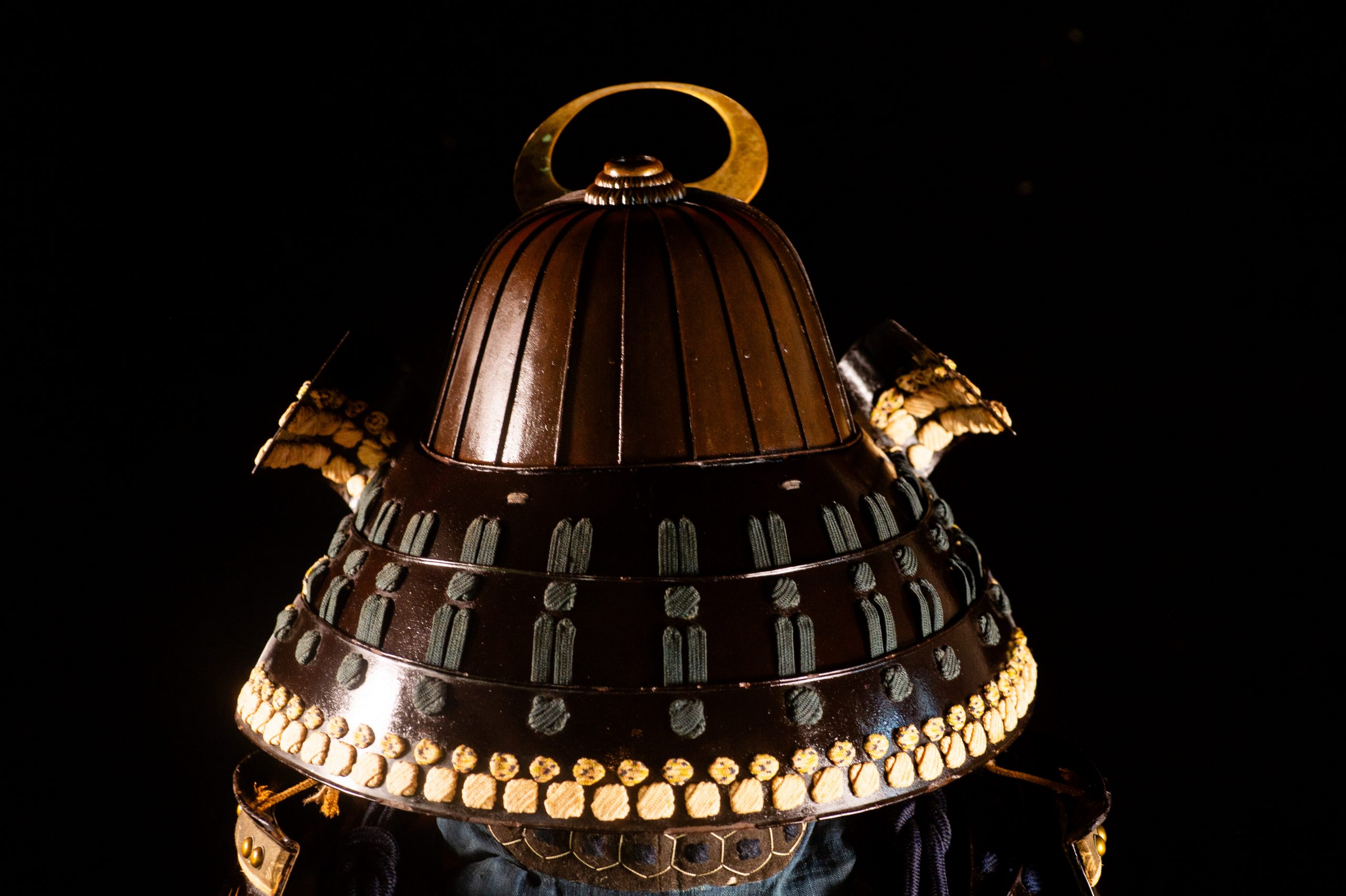
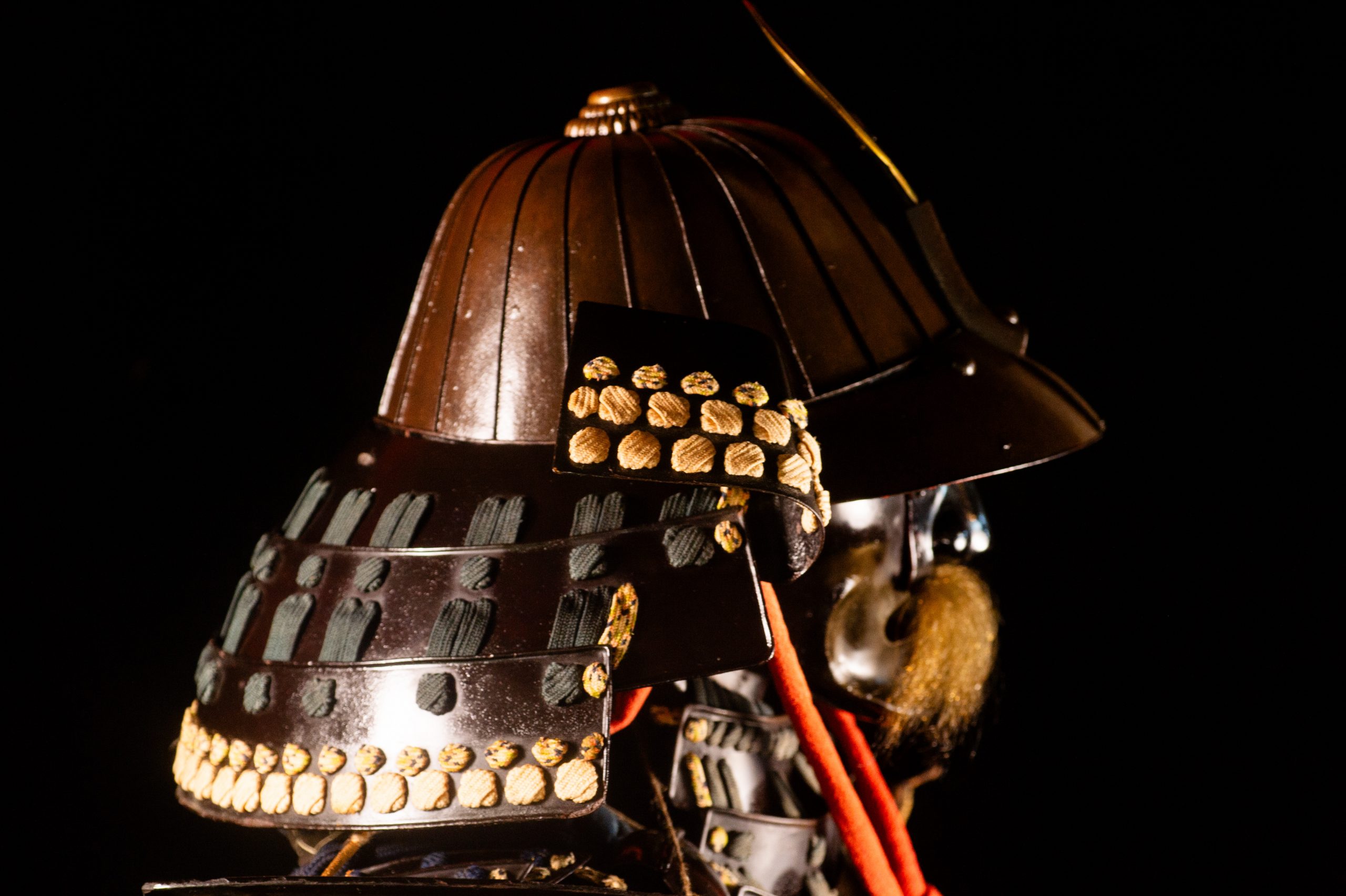
A suji-bachi style helmet bowl with pronounced vertical ribs/plates, finished in a glossy dark lacquer. The helmet is fitted with a gilt maedate shaped as an open ring/circle, strongly graphic, mounted on a metal bracket. The shikoro shows lacquered lames with dark-to-blue toned lacing, keeping a consistent palette across the entire set. Gilt fittings and details add structure and visual rhythm along the outline.
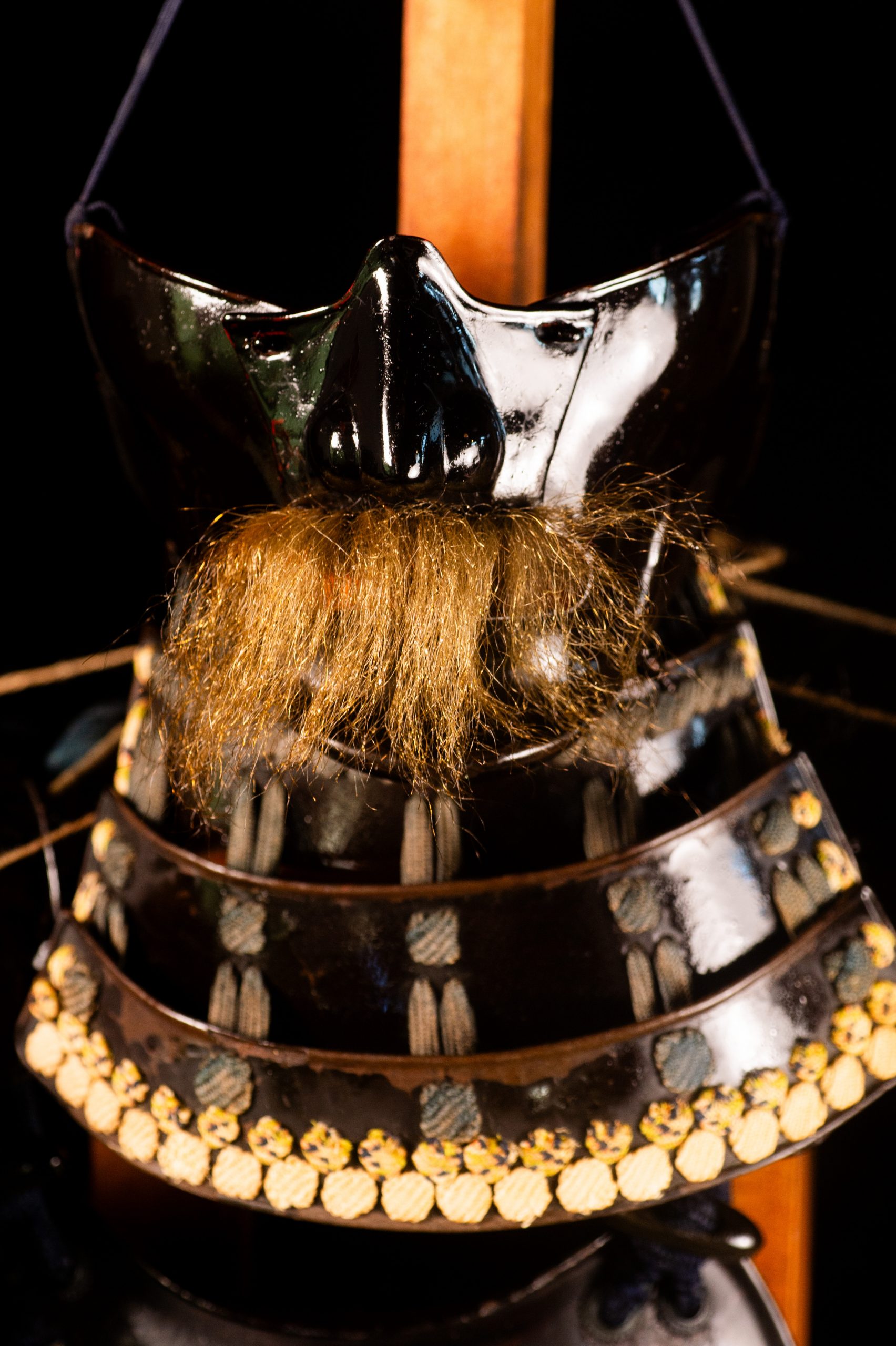
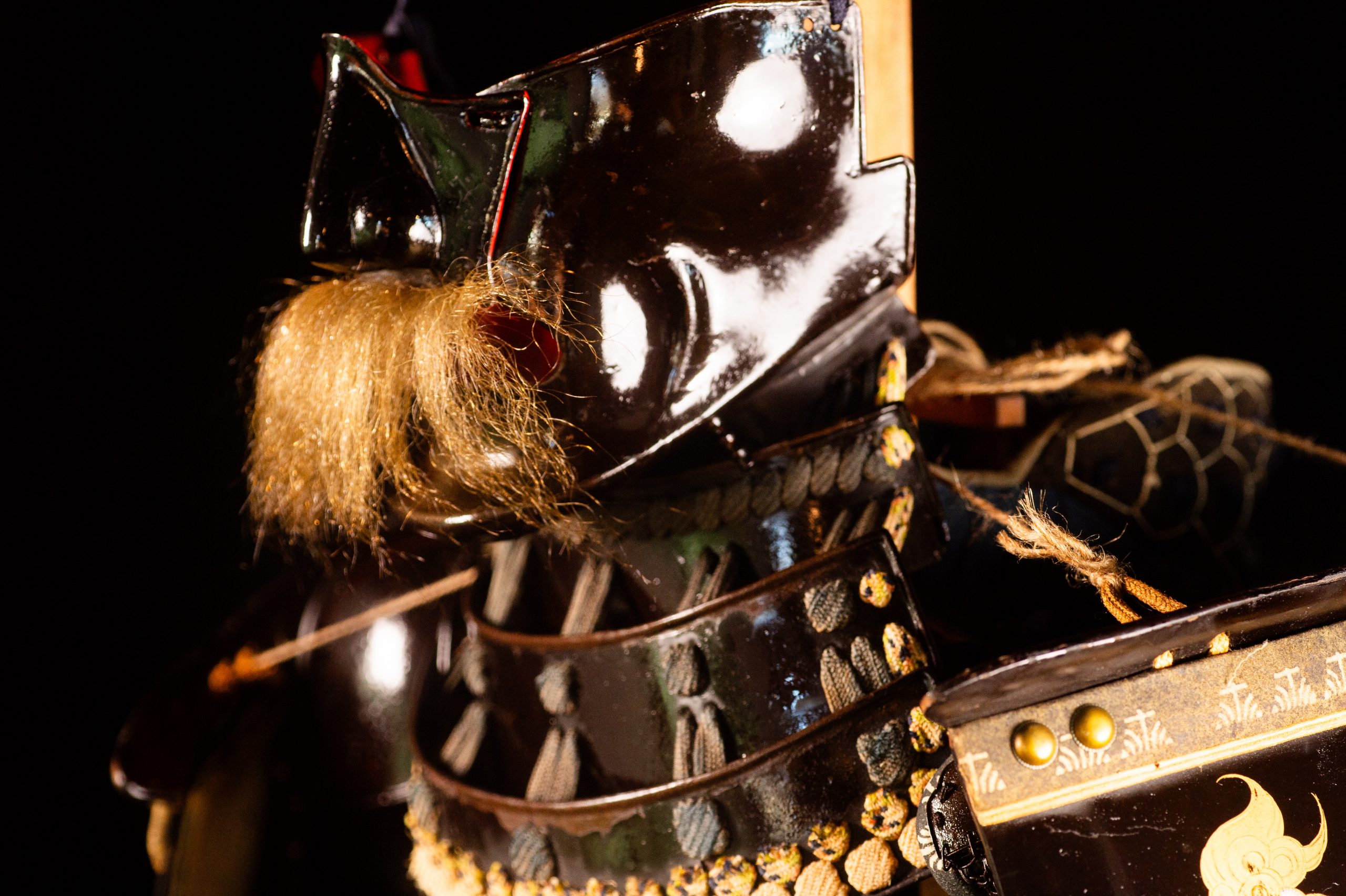
Menpō (face mask)
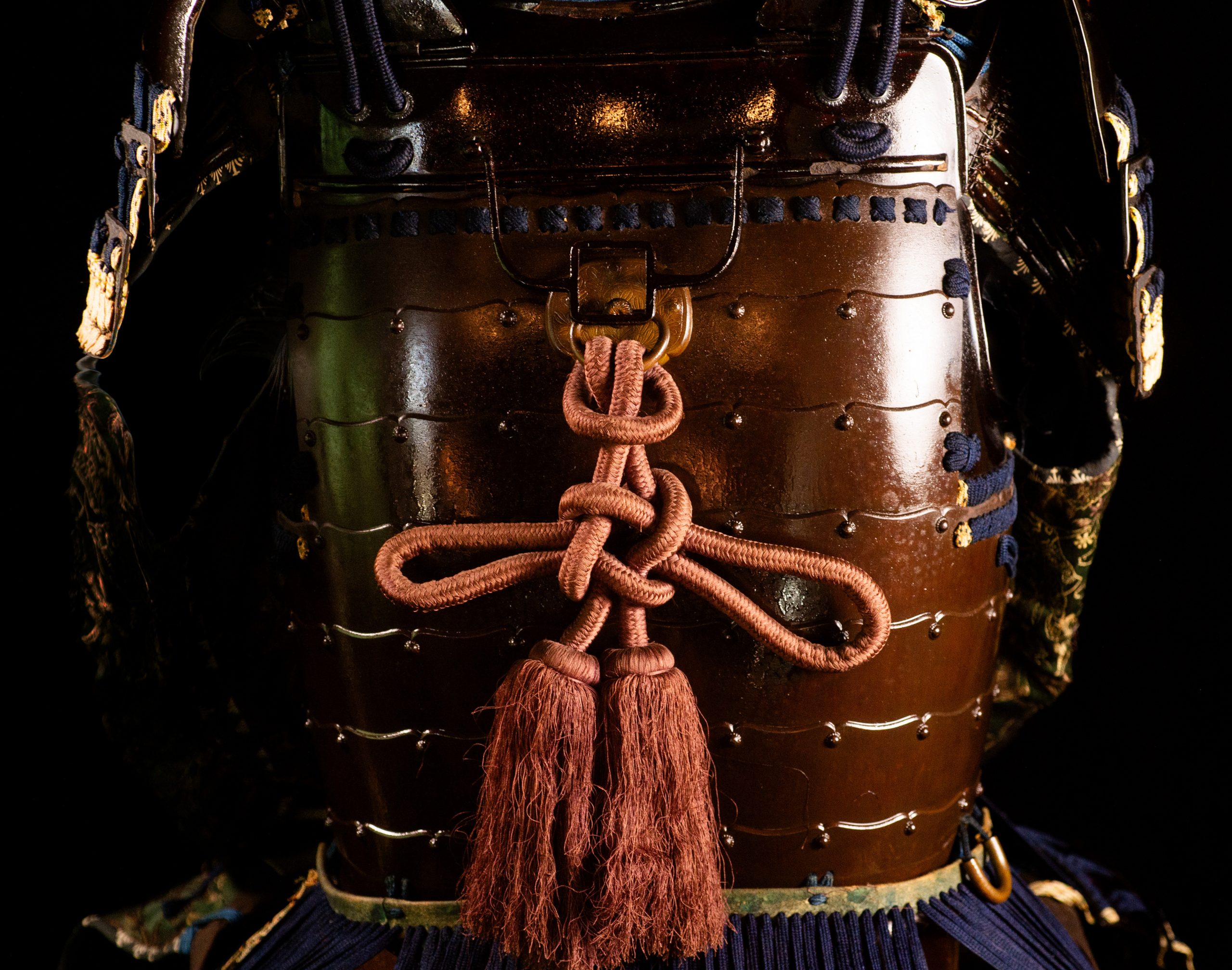
A menpō with a highly polished black finish, fitted with a moustache (kuchi-hige) that adds character and a classic “war armor” profile on display. The front tying system remains in place with a red cord, serving both functionally and as the central chromatic focal point of the ensemble.
Dō (cuirass)
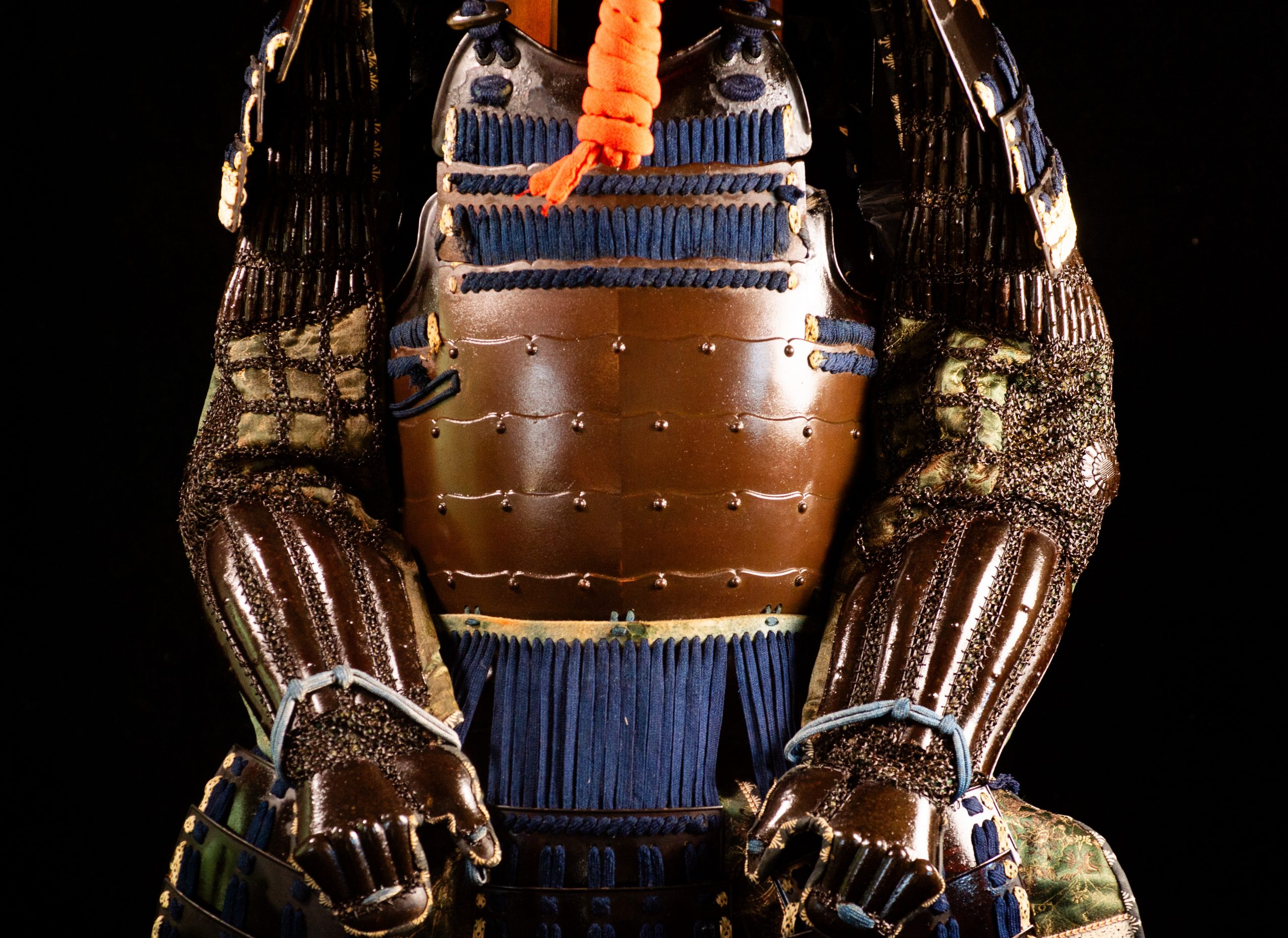
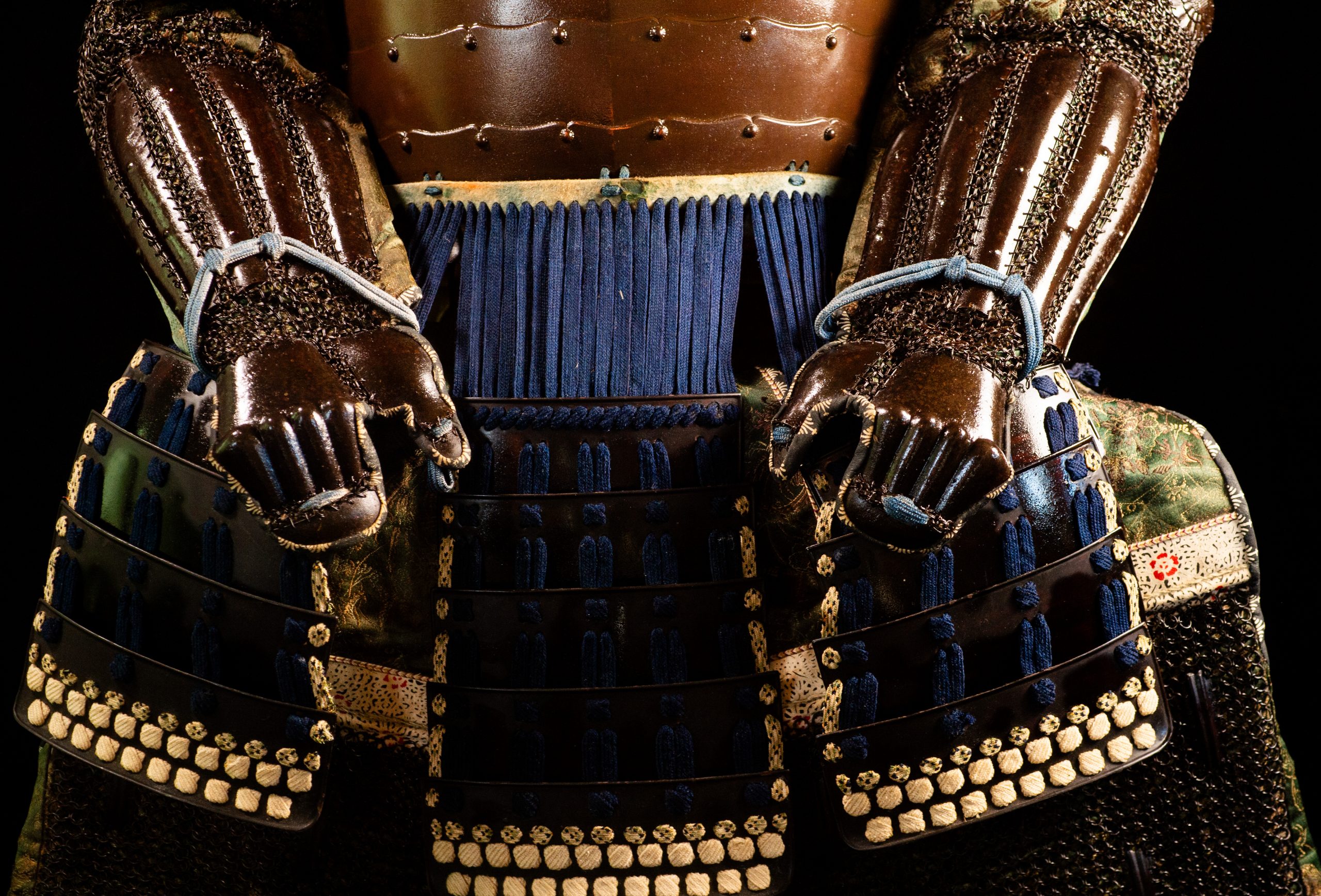
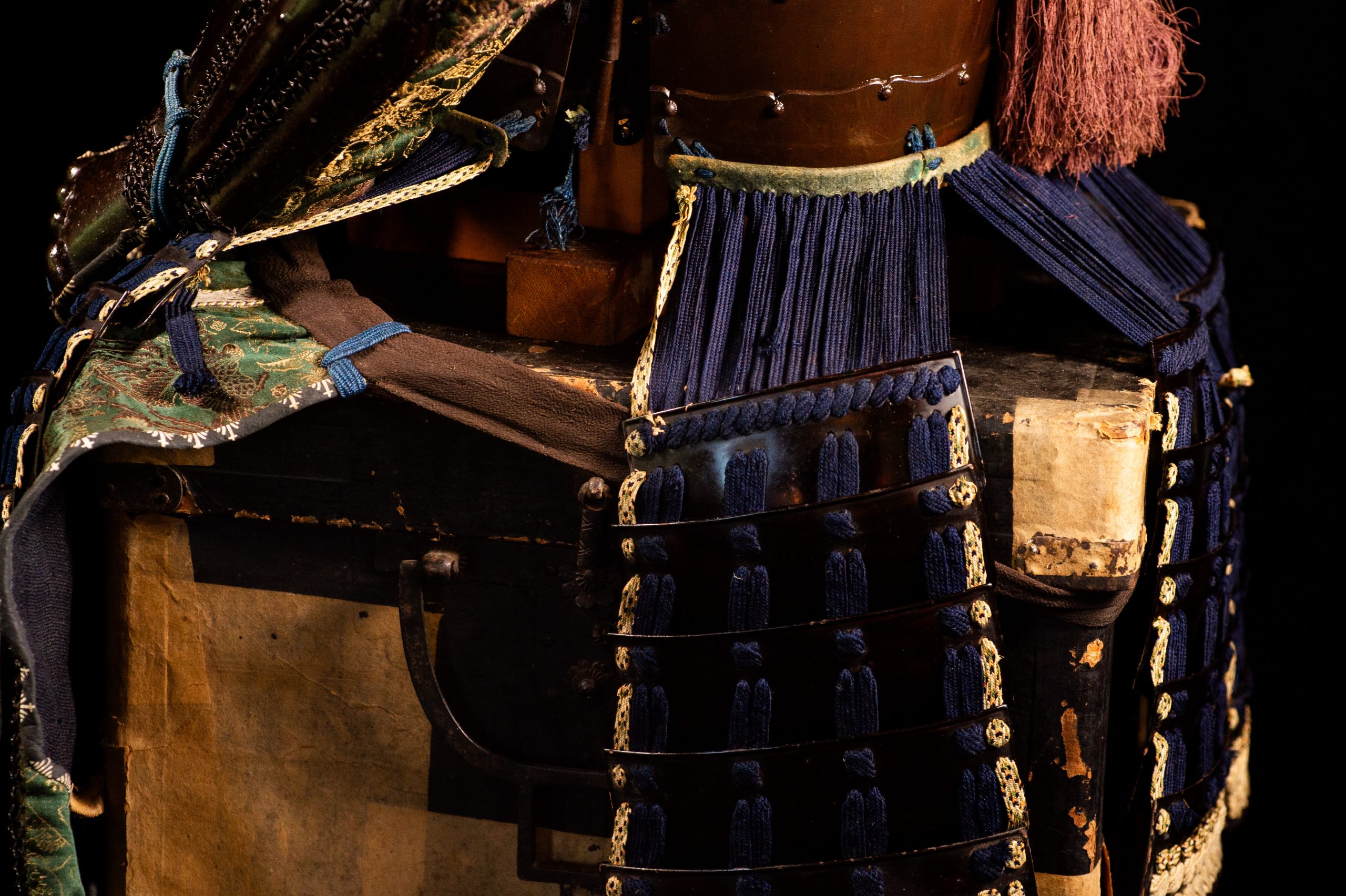
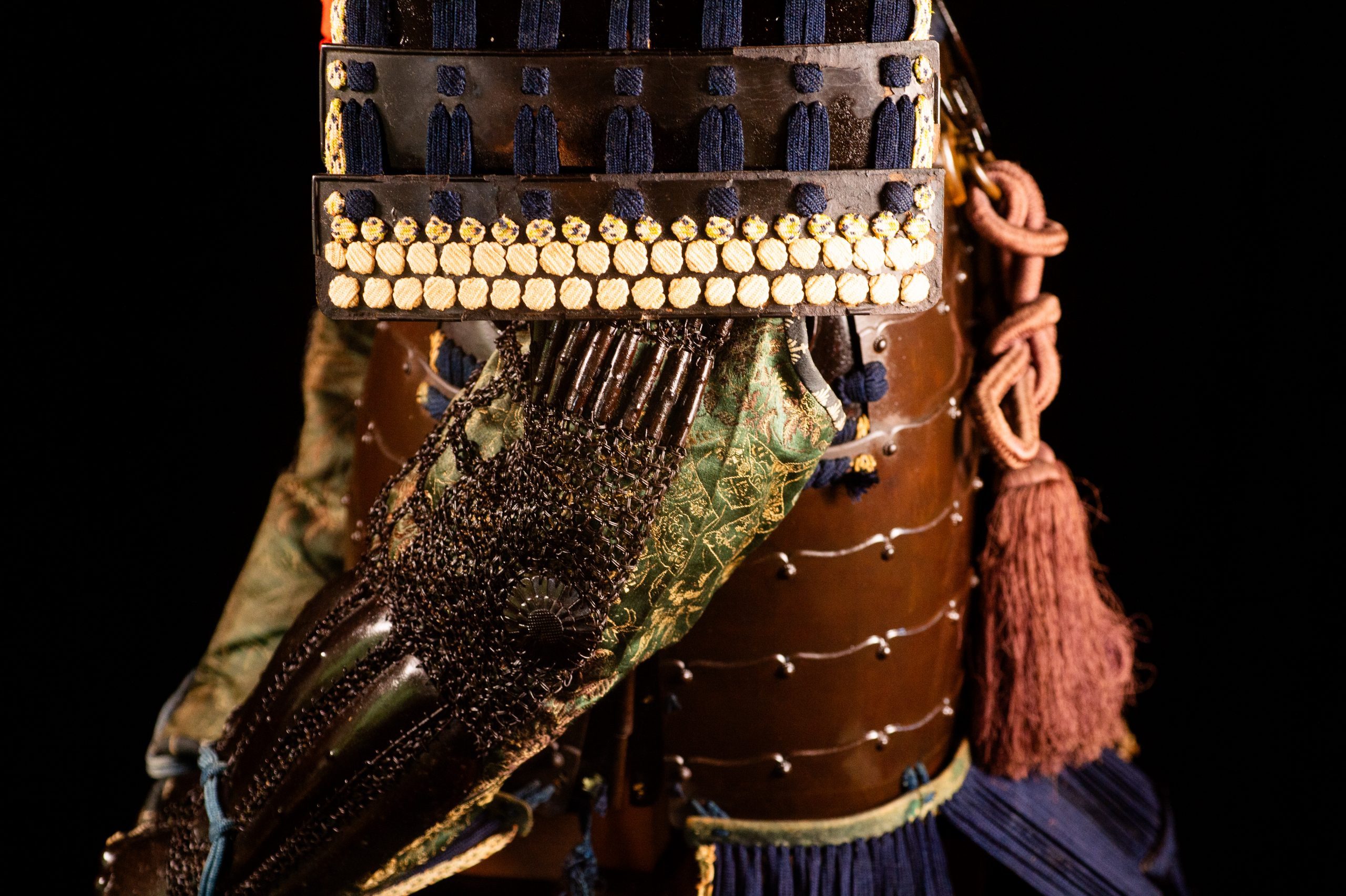
A horizontal-lamed cuirass of okegawa-dō type (yokohagi), lacquered in a deep brown tone with visible rivet work that emphasizes its construction. The upper area shows blue lacing work that reinforces the banded visual structure and ties the palette directly to the kusazuri. The overall impression is robust, restrained, and highly coherent as a collectible set.
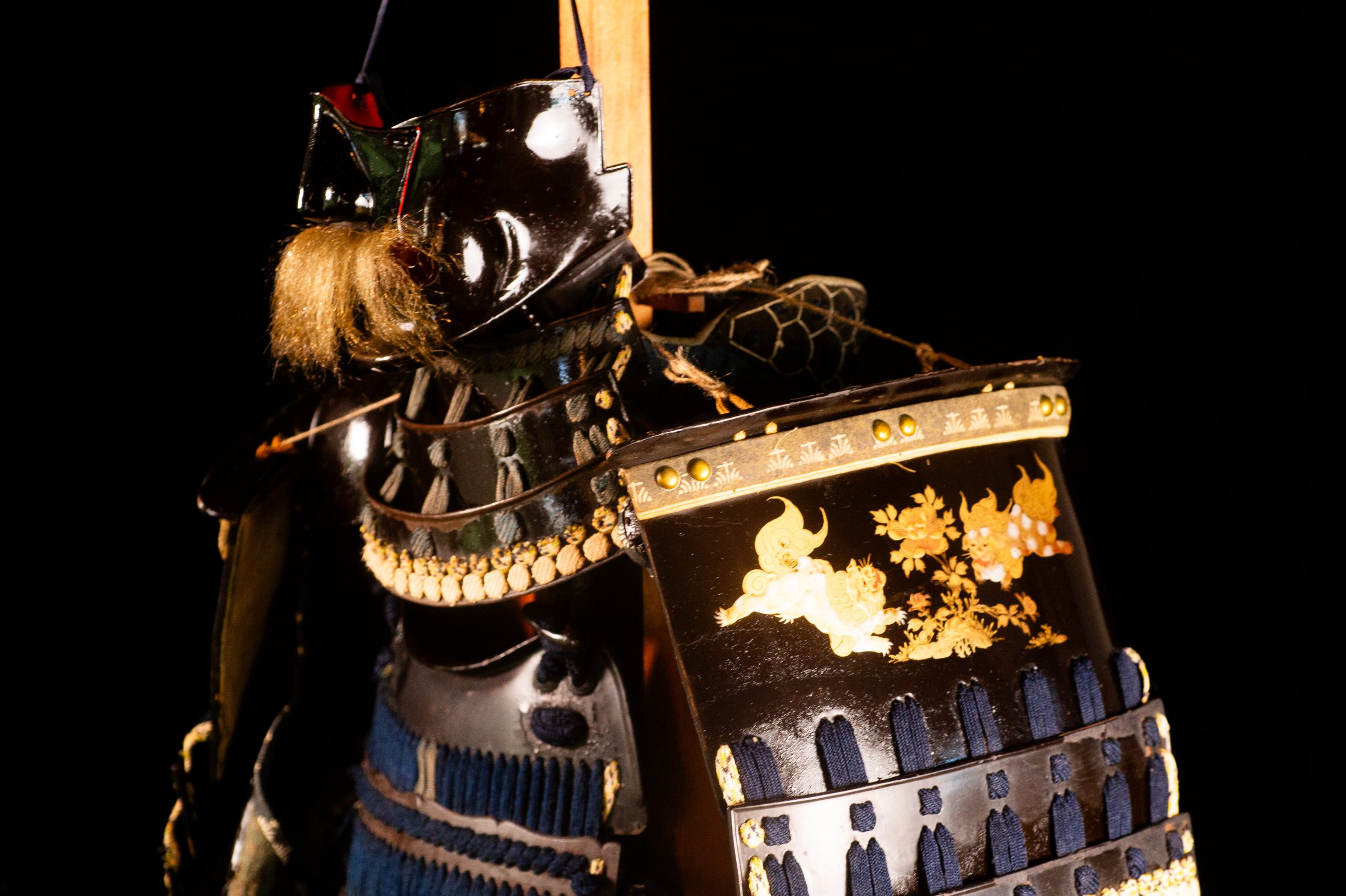
Sode (as a major work of art)
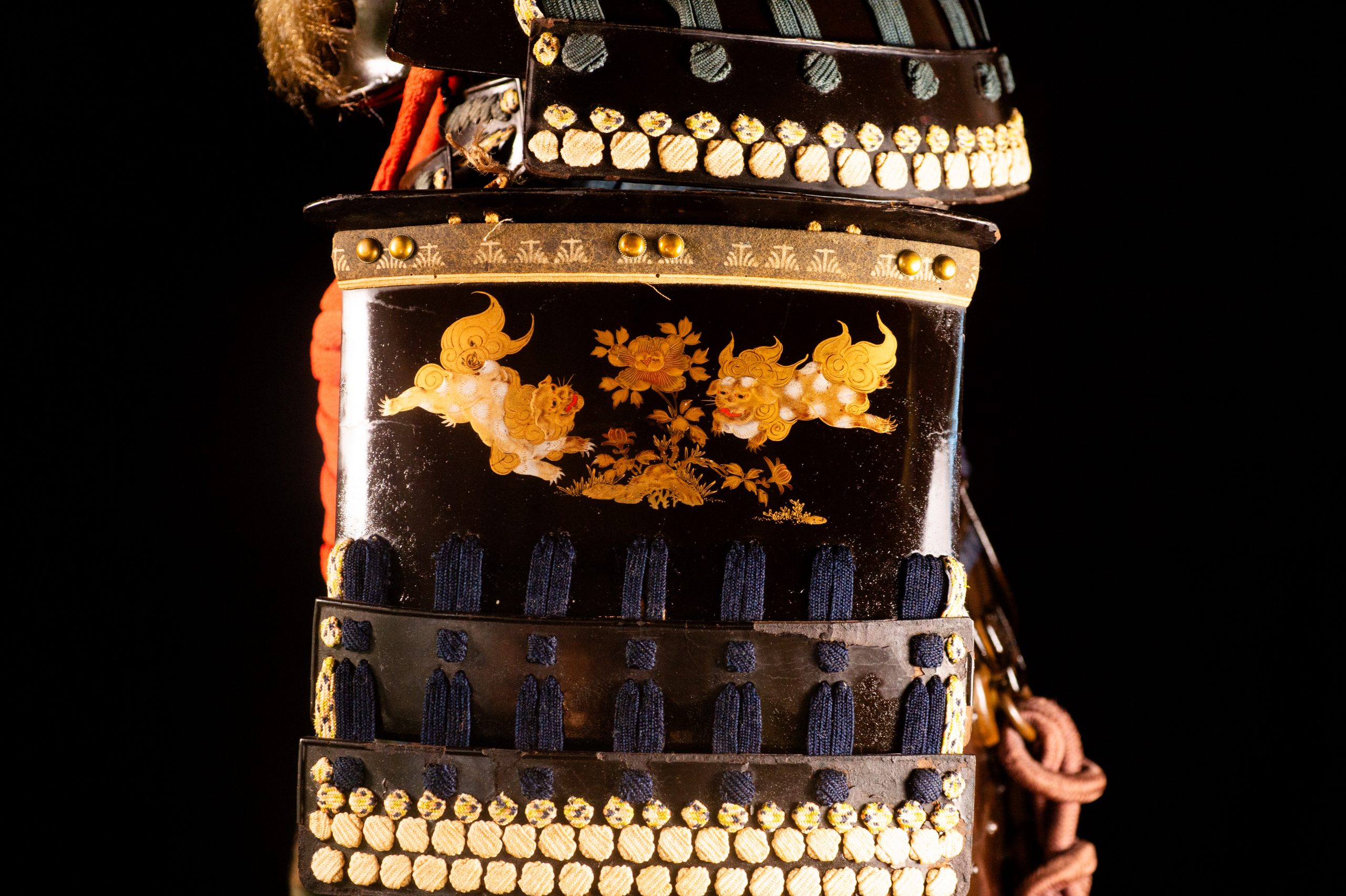
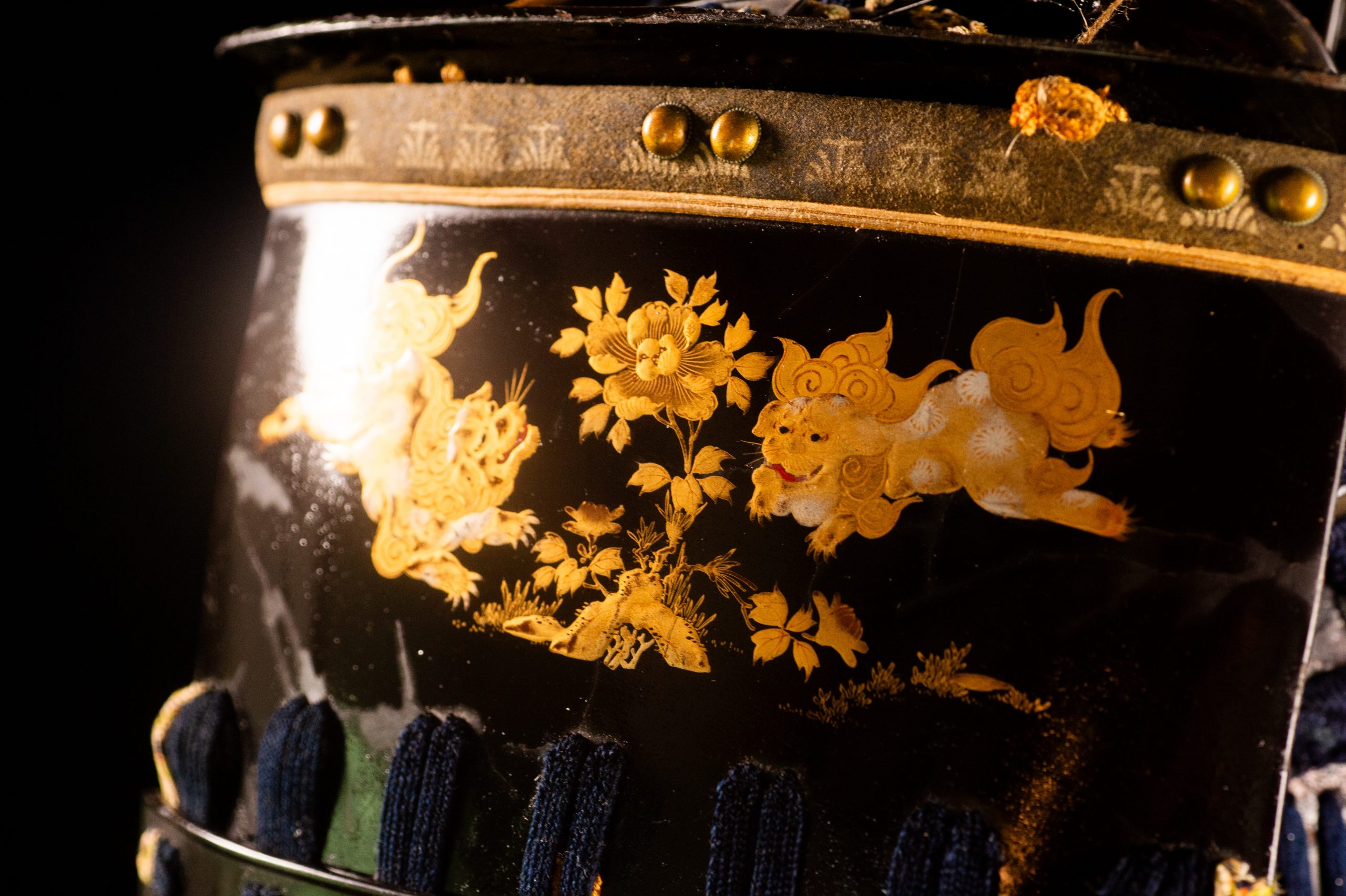
This is where the armor shifts register: the sode are not secondary components—they are the artistic statement.
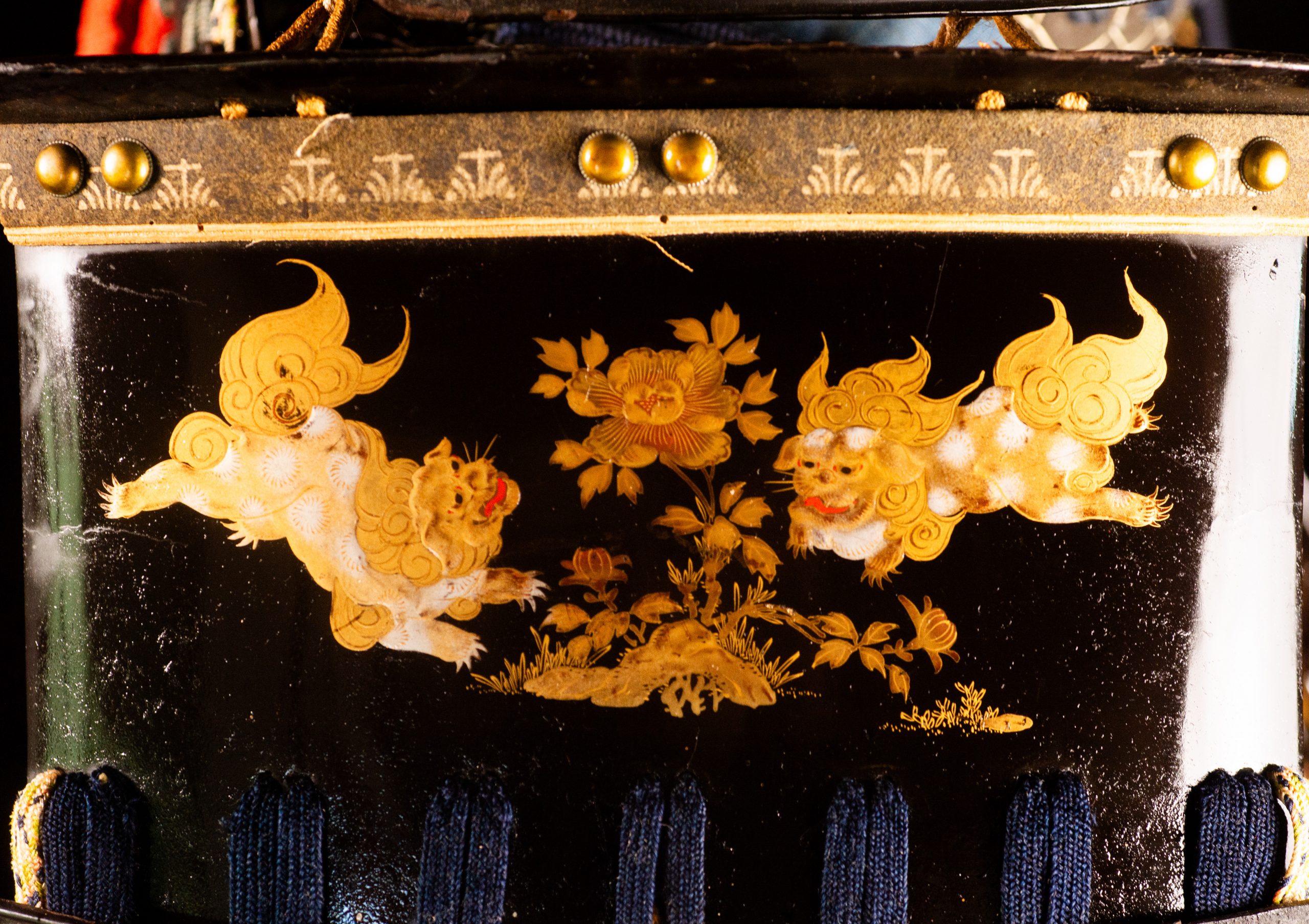
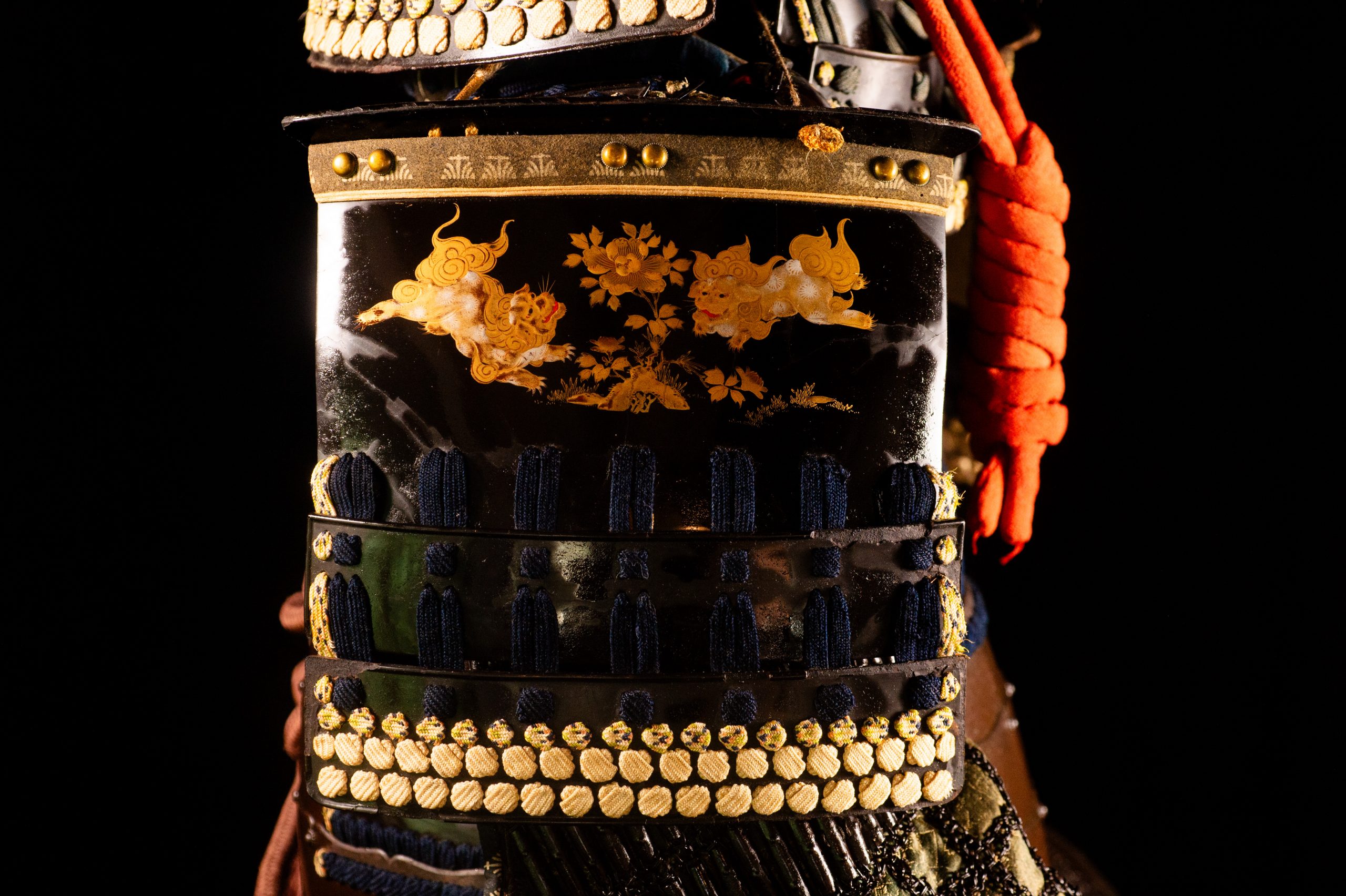
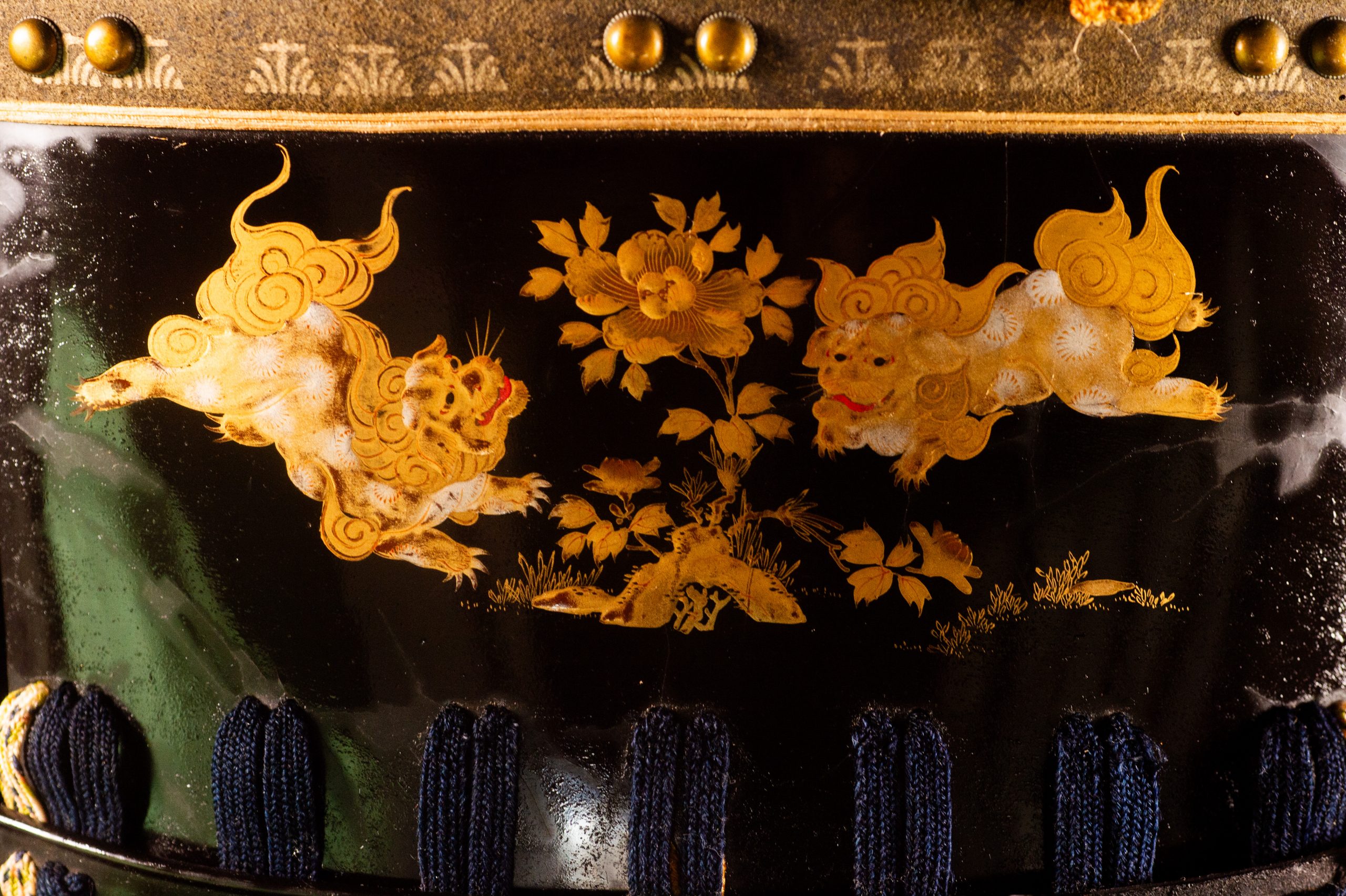
Large, black-lacquered, mirror-like panels become pictorial fields in high-impact gilt maki-e. The scene presents two shishi in a controlled, symmetrical confrontation, charged with contained energy, arranged around a central floral motif—the peony (botan), a classical emblem of nobility and prosperity—supported by vegetal elements and rocky ground that anchor the composition. This is not decoration for decoration’s sake; it is narrative lacquer work. The shishi appear suspended in motion, their manes and tails resolved in swirling forms that exploit gold-on-black language to suggest volume, tension, and air.
The central flower works both as a focal point and as a structural pivot: it balances the protective aggression of the guardian beasts with an almost courtly elegance. The final effect is unmistakably “school-like” lacquer: a deep black ground carrying living gold—clean reserves, fine linework, carefully weighted masses, and clarity from a distance. These are precisely the sode that elevate an armor from “good” to unequivocally museum-display collectible.
Kote and tekko (armored sleeves and gauntlets)
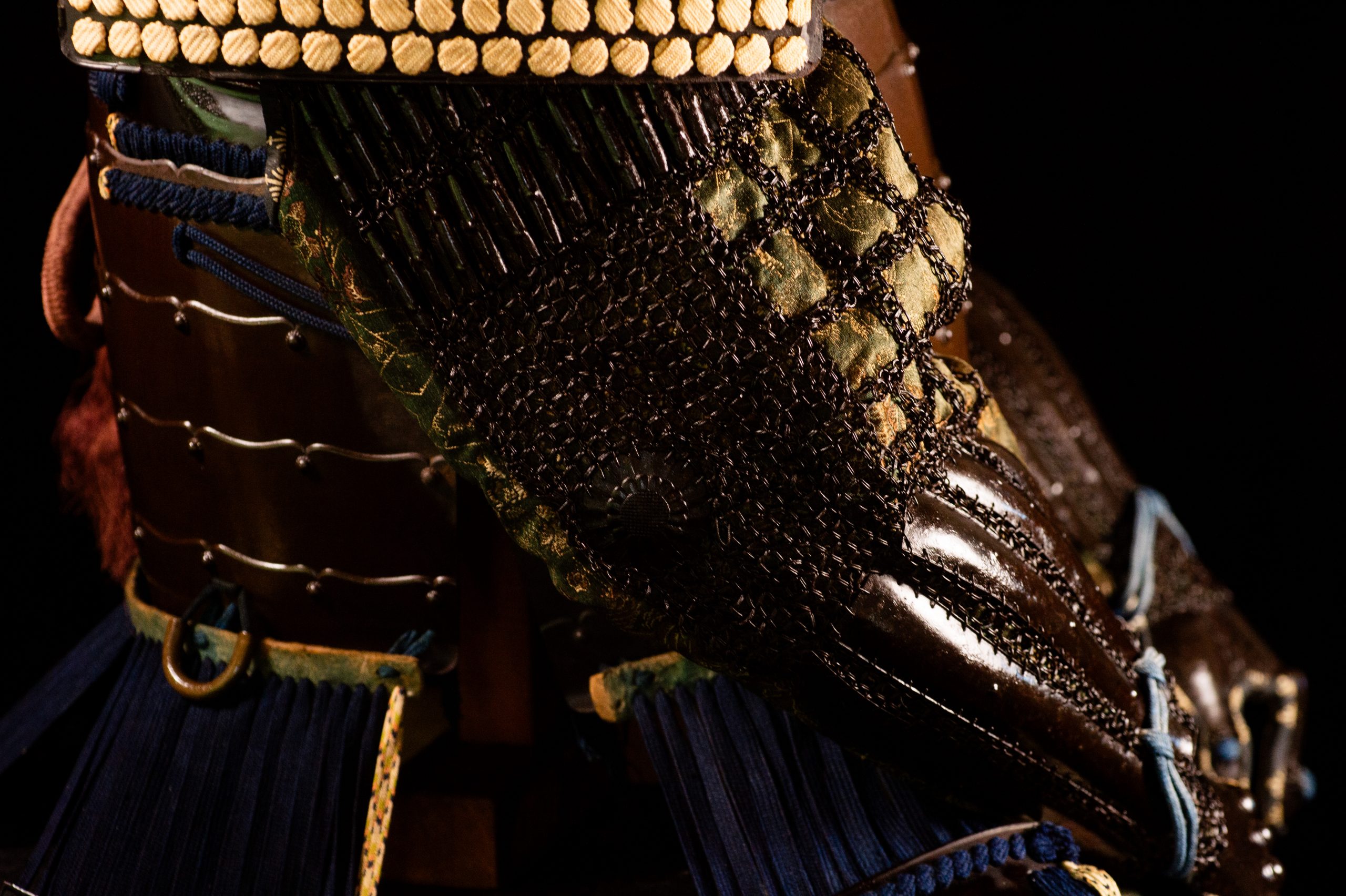
Armored sleeves combining kusari (mail) with kikkō (hexagonal) panels over a textile base, in dark and greenish tones that enrich the surface without breaking harmony. The forearms and hands are protected by rigid lacquered elements, adding volume and reinforcing the sense of a genuinely “complete” armor rather than a partial assembly.
Kusazuri (tassets)
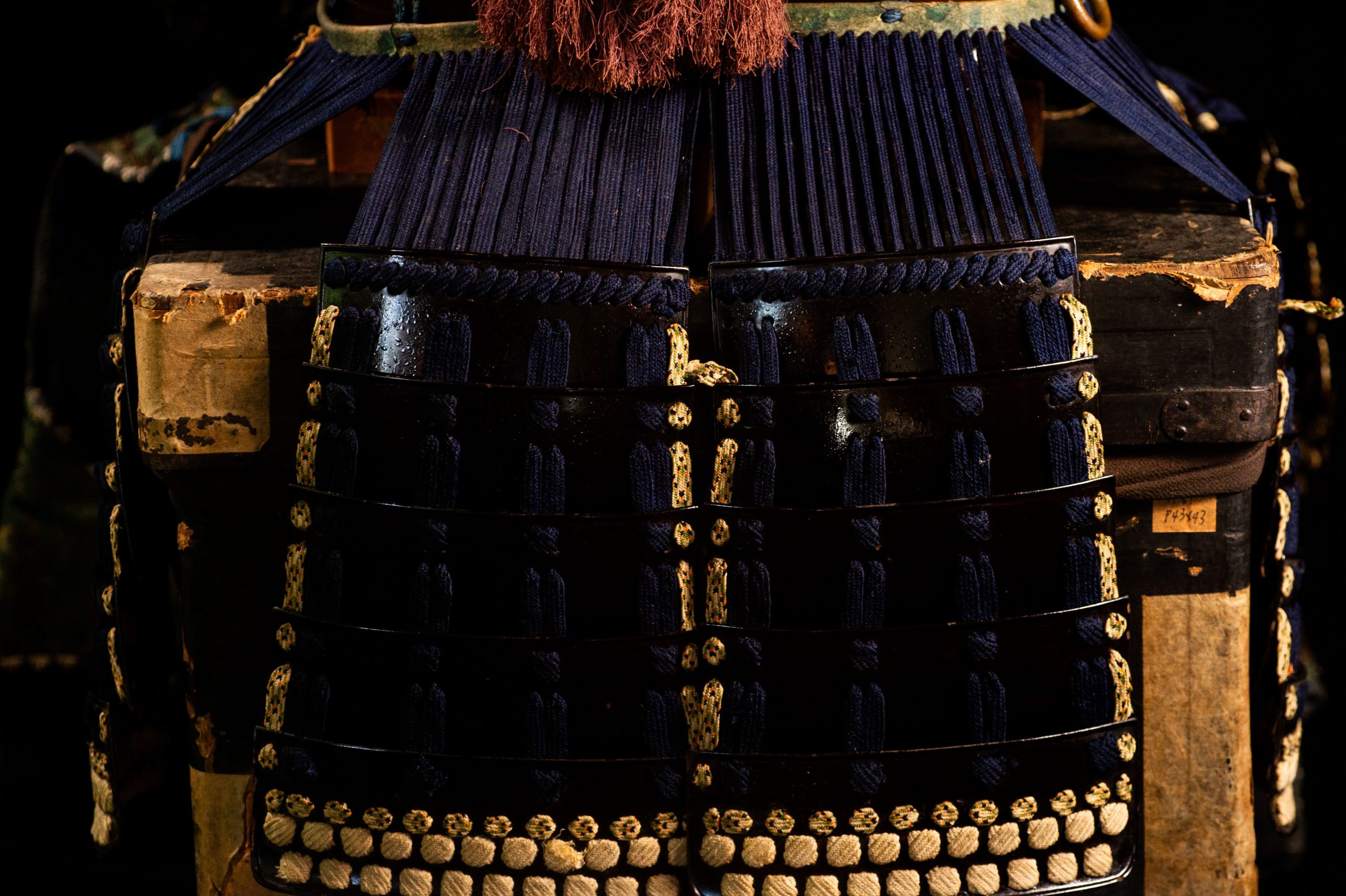
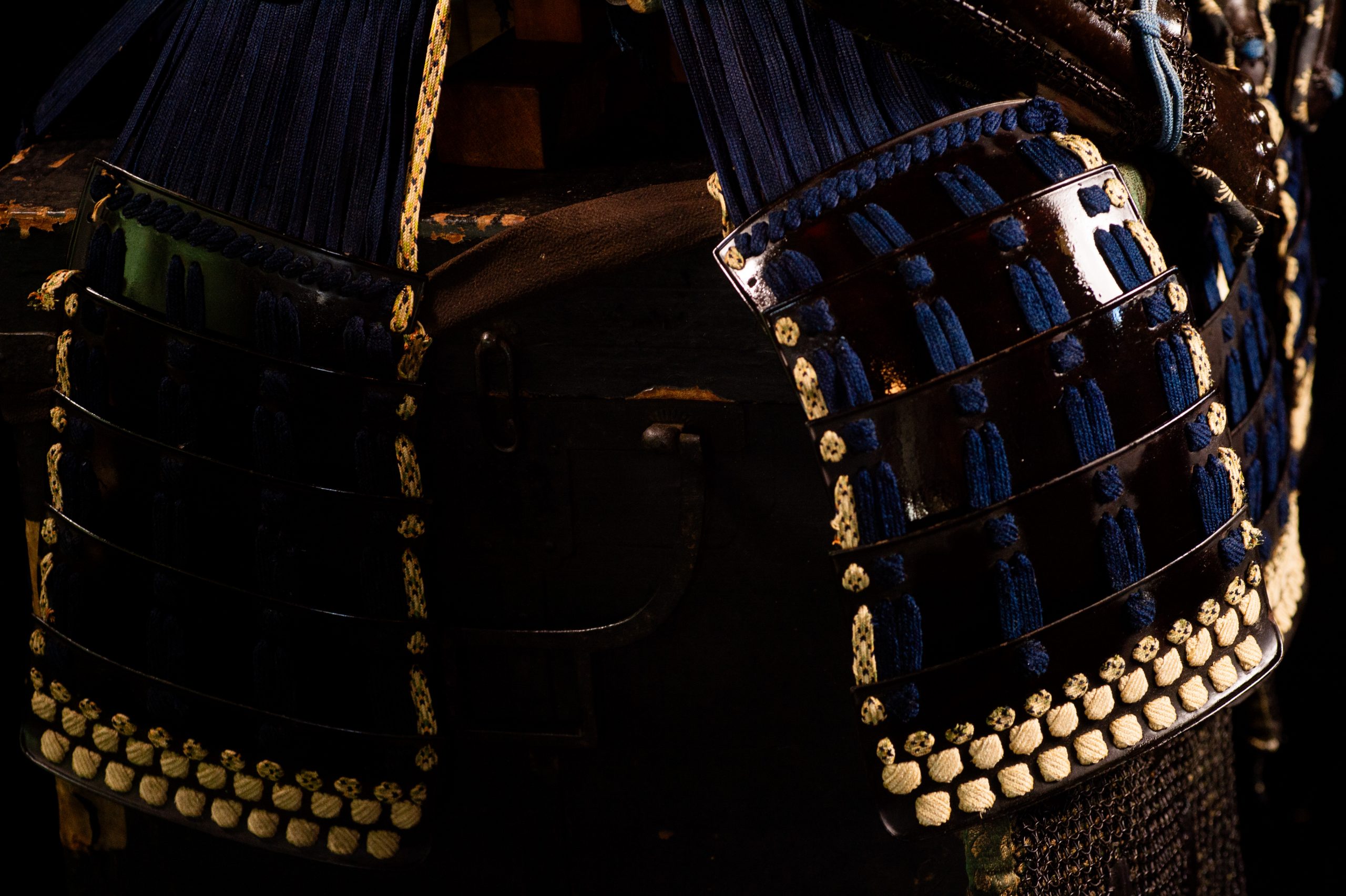
A dark-lacquer kusazuri with blue odoshi and a lighter lower edge, creating a rhythmic border that reads very well in frontal display. It maintains continuity with the dō and balances the visual weight of the kabuto/menpō.
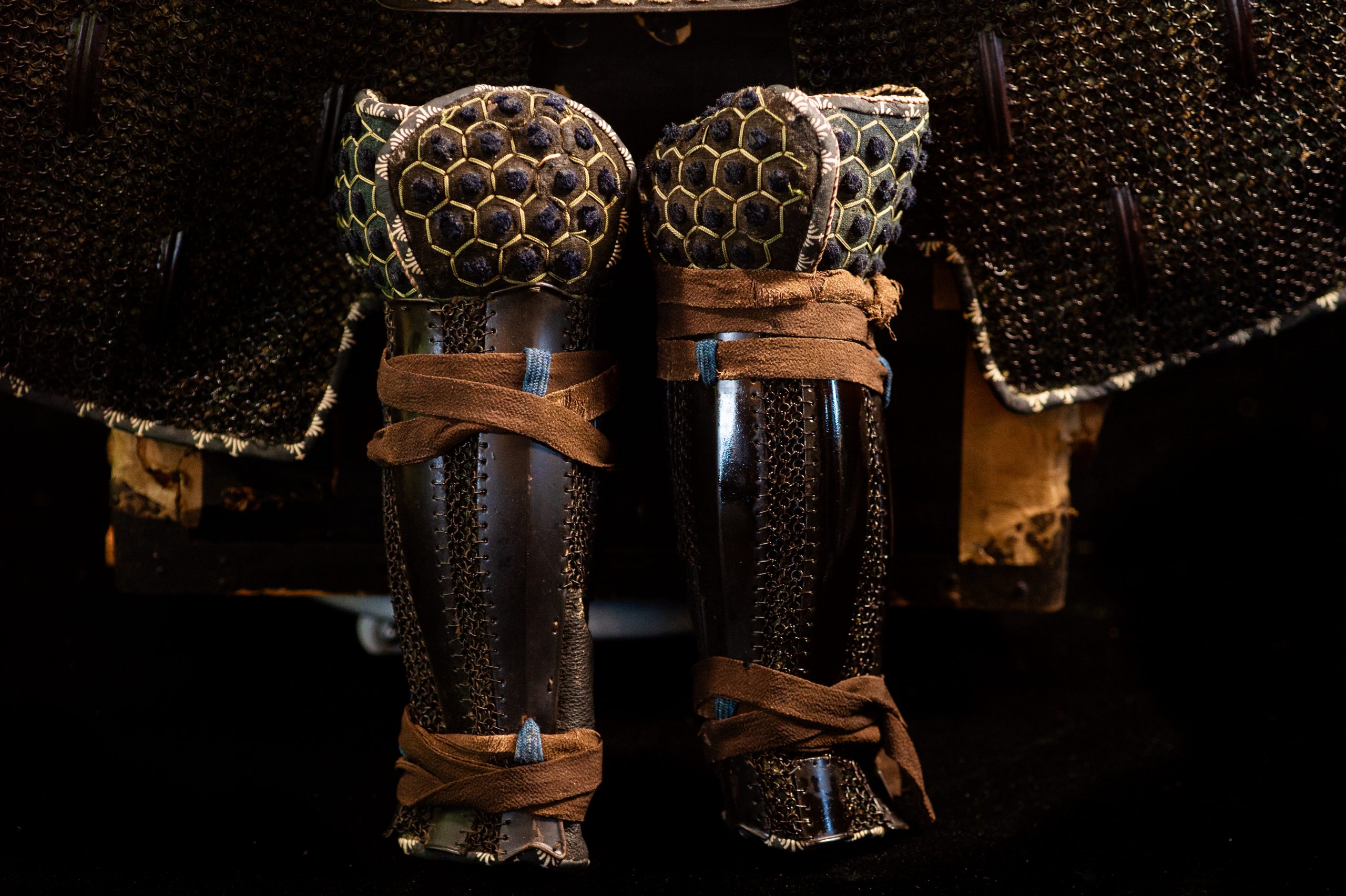
Suneate (shin guards)
Suneate featuring rigid lacquered shin plates with kusari at the sides, paired with padded kikkō-pattern knee guards. The tying cords are preserved in an earthy tone, showing honest age and wear consistent with period armor, without compromising the overall presentation.
Condition
Overall, the set presents as structurally sound and exceptionally strong for catalog display: glossy lacquer, full volume, and well-integrated major components. Expected age-related wear is visible in cords and textiles, consistent with a historical piece and not detrimental to the overall aesthetic read.